A long-term brand strategy is a written plan for who you serve, what you promise, and how you sound, which you keep consistent everywhere for years and review once a year. You won't need an ad budget for any of it.
In my work with therapy practices, the brands that hold up longest are rarely the flashiest. They belong to practices that kept one promise long enough for a whole town to remember it.
Pulling that off takes a plan you're willing to revisit every year, not a marketing degree (though a calendar reminder helps).
TL;DR Quick Answers
Brand Marketing For Therapists
Brand marketing for therapists is how a private practice shows the right clients who it helps, what it promises, and how it sounds, then keeps that message the same on every platform for years. Done well, it builds trust before the first session and recognition that keeps growing long after launch day.
What keeps it working over the long haul:
Name a person, not a diagnosis, so your niche still fits after your methods change.
Keep every listing identical, from your website to Psychology Today and your Google profile.
Audit once a year and refresh long before you ever rebrand.
Make only claims you can keep, with no promised outcomes and testimonials only where your ethics code allows them.
Top 5 Takeaways
A brand you can't keep consistent for five years works more like a campaign, however good it looks at launch.
Name a person instead of a diagnosis, since that niche survives a change in methods.
Audit every touchpoint once a year, because matching details are the cheapest trust signal you'll find.
Refresh before you rebrand and hold on to the name and promise clients already recognize.
Honest claims grow more believable with time, while hype is something you'll eventually have to walk back.
What Makes A Therapy Brand Last Longer Than A Logo?
A therapy brand lasts when the promise underneath it stays put, even after the colors change. A logo takes an afternoon. Keeping a brand takes years of making the same small decision every time you update a bio or answer a new inquiry.
If you're still working out who you serve and how you sound, start with this guide to brand marketing for therapists, then come back here to plan the next five years.
I think of a brand the way most therapists think about referral relationships. One good lunch with a physician won't fill your calendar, though showing up the same way for years usually does. The same idea sits behind any practical brand extension strategy, whatever the industry.
How Do You Build A Brand Foundation In Year One?
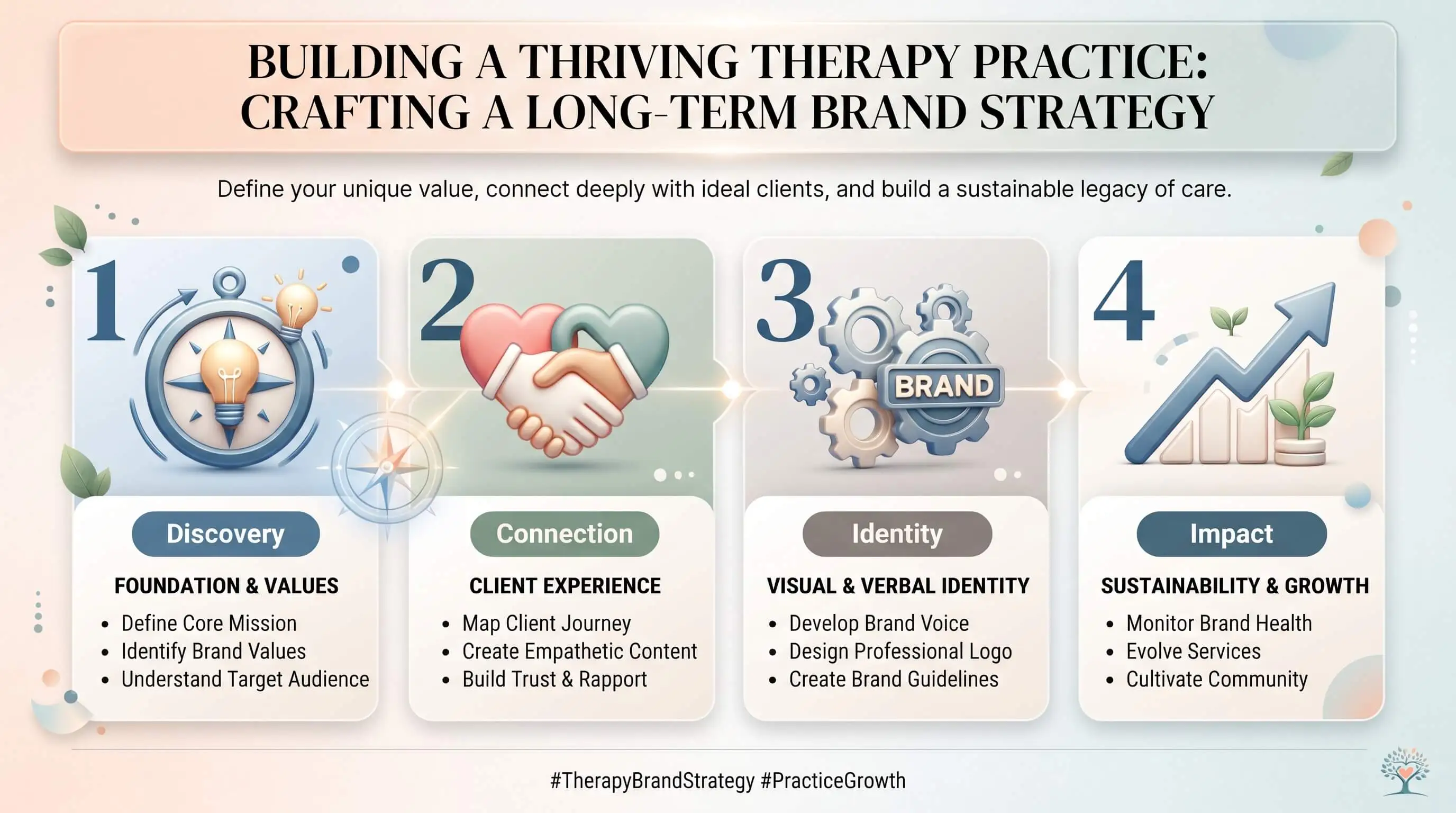
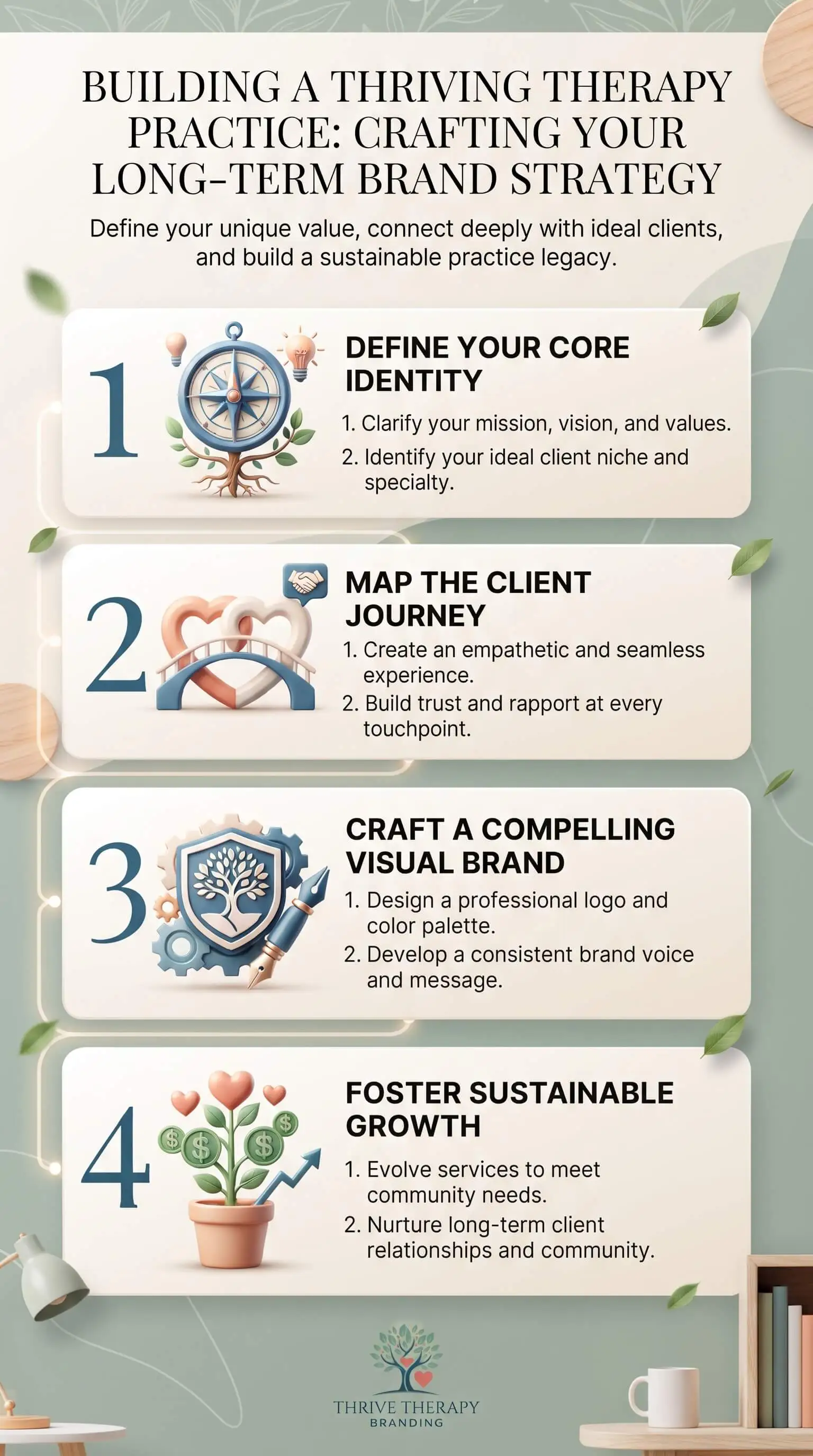
Year one comes down to four choices you won't want to remake in year three.
Name A Person, Not A Diagnosis
Where "anxiety" names a condition, "new parents who lie awake running worst-case scenarios" names a person. The second version still makes sense five years from now, even after your methods change.
Write A One-Sentence Promise You Can Keep
Compare "evidence-based, client-centered care" with "I help couples stop having the same fight." Only one of those gives a stranger a reason to call you tonight. If you can't picture keeping your promise in 2031, rewrite it now.
Choose A Practice Name You Can Grow Into
Your own name feels personal and keeps things simple, right up until you hire an associate. A practice name leaves room to grow, as long as you don't tie it to one modality or one neighborhood. Search federal trademark records before you order business cards.
Set Voice Rules Someone Else Could Follow
Write down a handful of rules, like plain words, short sentences, no promised outcomes, and warm but boundaried. Then picture handing them to a future associate. If that person couldn't follow them, keep tightening. This guide to brand voice guidelines that build trust pairs well with the exercise.
How Does Brand Marketing For Therapists Change From Year One To Year Five?
The work slowly shifts from building the brand to protecting it. Here's the pattern I see most often, though your caseload and goals will set your own pace.
Foundation (months 0 to 12): Settle your niche, promise, name, and voice, then put it all on a one-page brand guide.
Consistency (years 1 to 2): Put matching details on every platform and run your first touchpoint audit.
Authority (years 2 to 3): Answer the questions clients ask you most, ideally in one helpful article a month.
Expansion (years 3 to 5): Add services or clinicians under one brand, and decide whether a refresh or a rebrand fits.
Legacy (year 5 and on): Write the brand down clearly enough that it could outlast any one clinician.
How Do You Keep A Therapy Brand Consistent Everywhere Clients Look?
Consistency is the cheapest trust signal you'll ever buy. A future client might check your website and your directory profile within the same ten minutes. If those look like two different practices, doubt shows up before the first call does.
Run a touchpoint audit once a year. Line up your website, Google Business Profile, Psychology Today and other directory listings, intake email, voicemail greeting, and paperwork, then fix whatever doesn't match.
Match your name, address, and phone number everywhere. Search engines and AI tools cross-check those details, and mismatches confuse both.
Change everything on the same day. A new headshot that only reaches your website creates the drift you're trying to prevent.
Keep a one-page brand guide with your promise, niche, voice rules, approved bio, headshot, and colors. A fuller brand bible can wait until you need one.
When Should A Therapy Practice Evolve Its Brand?
Evolve when the brand stops describing the work you do. Watch for wrong-fit inquiries, a niche you've quietly outgrown, a headshot older than your car loan, or services your website never mentions.
Refresh before you rebrand. A refresh updates your words and visuals but keeps your name and promise. A rebrand swaps one of those out and resets some of the recognition you spent years earning. Most practices need far more of the first than the second.
Moving from solo to group practice is the big exception. Decide early whether clients choose the practice or the clinician, and build every page around that answer. Following medical copywriting tips can help keep your messaging clear and consistent as your practice grows.
How Do You Know Your Brand Strategy Is Working?
No single number will tell you, but over a year or two the patterns start to show:
More people are searching for your practice by name in Google Business Profile and Search Console.
More answers on your intake form's "How did you hear about us?" questions that match your niche.
A higher share of consults that turn into first sessions.
Fewer inquiries from people you can't help.
Any one of these can wobble month to month. Taken together over a year, they show whether the right people are finding you.
What Ethical Guardrails Keep A Therapy Brand Trustworthy Over Time?
Whatever you claim in year one still has to be true in year five, so leave promised outcomes out from the start and treat every newsletter as a privacy decision. Testimonial rules vary by profession. Psychologists, counselors, social workers, and MFTs each answer to their own ethics code, and I'm a copywriter, so your licensing board always gets the final word. The same commitment to accurate, responsible messaging matters when working with school consultants who serve families and students. Honest marketing ages well, and hype ages fast.
"I spent ten years in the ministry before I ever wrote a line of copy, and the lesson carried over almost word for word. In a congregation, trust built slowly, one ordinary Sunday at a time, and a single great sermon never did much on its own. I watch the same thing happen with therapy practices online. The ones that grow chose a promise they could keep and then kept it, on every page, long enough for their town to recognize them. Most of the brand problems clients hire me to fix turn out to be consistency problems that took five years to build."
7 Essential Resources
Before you change a single profile, here's where I'd send you. I've ordered these the way you'll probably need them, from naming your practice to planning next year's marketing, and every one is a primary source.
1. Protect Your Practice Name Before It Becomes An Asset
The USPTO explains what a trademark covers and why searching for similar names comes first. Read it before you print business cards, not after a competitor files.
Source: U.S. Patent and Trademark Office: Trademark Basics
2. Write In A Voice Clients Understand On The First Read
The federal plain language guides teach you to write for one specific audience and then test whether that audience understood you. I haven't found better free voice training for therapists.
Source: Digital.gov: Plain Language Guide Series
3. Keep Your Google Listing Accurate And Easy To Find
Google says local results depend mostly on relevance, distance, and prominence, and that complete, accurate profile details help. Use it as the checklist for your yearly touchpoint audit.
Source: Google Business Profile Help: Tips To Improve Your Local Ranking
4. Know What Your Ethics Code Says About Public Statements
Standard 5 of the APA Ethics Code covers public statements, including directory listings and testimonials. Counselors, social workers, and MFTs should read their own codes with the same care.
Source: American Psychological Association: Ethical Principles Of Psychologists And Code Of Conduct
5. Make Claims You Can Still Defend In Five Years
The FTC's guide explains that ads must be truthful and that you need evidence for a claim before it runs. A brand built on claims you can back up never has to walk them back.
Source: Federal Trade Commission: Advertising FAQs, A Guide For Small Business
6. Protect Client Privacy In Every Newsletter
HHS explains how the HIPAA Privacy Rule defines marketing and when you need a client's written authorization. Read it before your brand lands in anyone's inbox.
Source: U.S. Department of Health And Human Services: HIPAA Marketing Guidance
7. Turn Your Brand Into A Yearly Marketing Plan
The SBA walks through target market, competitive advantage, budget, and measuring results, and it suggests revisiting your plan at least once a year. That happens to be the same rhythm a long-term brand needs.
Source: U.S. Small Business Administration: Manage Your Business, Marketing And Sales
Supporting Statistics
I keep these three numbers in mind whenever a therapist asks me whether long-term branding is worth the effort.
1. More Practices Are Opening Their Calendars To New Clients
In APA's 2025 Practitioner Pulse Survey of 1,742 psychologists, 46% had no openings for new patients, down from 53% in 2024.
As more calendars open, more practices compete for the same clients, and the practice people recognize usually gets the call.
Source: American Psychological Association: Among Psychologists, AI Use Is Up, But So Are Concerns (2025)
2. About One In Three Psychologists Works Outside Insurance Networks
APA's 2024 survey found that 34% of psychologists didn't accept any form of insurance.
Without an insurance directory sending people your way, a private-pay practice relies on recognition and word of mouth, which is brand work by another name.
Source: American Psychological Association: 2024 Practitioner Pulse Survey
3. Demand For Therapists Is Projected To Keep Outpacing Supply
HRSA projects 2038 shortages of about 99,780 mental health counselors, 99,840 psychologists, and 33,840 marriage and family therapists, measured in full-time equivalents and based on current use of services.
High demand won't guarantee the right clients find you. When people have plenty of names to choose from, they tend to pick the practice that's easiest to recognize.
Source: Health Resources And Services Administration: Health Workforce Projections
These statistics highlight the importance of long-term branding for therapists as competition increases, insurance participation varies, and demand for mental health services grows. Private practice healthcare copywriting helps therapists communicate their value, build recognition, and connect with the right clients through clear, trustworthy messaging.
Final Thoughts And Opinion
Here's where I land after years of writing for healthcare practices. A long-term brand strategy is mostly patience and paperwork. It takes a one-page guide and a yearly audit. Mostly, though, it takes discipline to keep saying the same true thing long after you're tired of hearing yourself say it.
The therapists I see struggling in year five rarely started with a bad brand. They had a good one and stopped tending it. A new service went live without its own page. A bio changed on the website and never made it to the directories.
The ones who thrive pick a promise they can keep for a decade and show up the same way everywhere a client might look. They review the whole thing once a year, the way they'd review a treatment plan, and fix drift the week they spot it.
Honestly, most practices don't need a full rebrand. If your name and promise still fit, a refresh and a consistency audit will do more for you than a new logo ever could. The same principle applies to a board game crowdfunding strategy, where refining an existing message can be more effective than starting over. I'll tell you that even when it means a smaller project for me.
Frequently Asked Questions
Q: How Long Does It Take To Build A Brand For A Therapy Practice?
A: A therapy practice brand usually takes about a year to set up and two to three years to feel established. You can settle your niche, promise, name, and voice within a few months. Recognition is slower. It builds each time clients and referral sources see the same thing again.
Q: Should My Therapy Practice Be Named After Me?
A: It depends on where you're headed. A practice named after you feels personal and works well if you plan to stay solo, while a practice name gives you room to hire associates without a rename. Either way, search federal trademark records before you commit.
Q: How Often Should A Therapist Rebrand?
A: Rarely. Most therapists need a refresh every few years, with fresh words and photos. Save a full rebrand for a genuine change in who you serve or what you promise.
Q: How Is Brand Marketing For Therapists Different From Regular Advertising?
A: Brand marketing for therapists builds recognition and trust over years, while advertising buys attention only as long as you keep paying. When an ad campaign ends, a consistent brand keeps working through your website and word of mouth.
Q: How Do I Keep My Brand Consistent Across Psychology Today And Google?
A: Use one approved bio, one headshot, and the same practice name, address, and phone number on every platform. Keep all of it on a one-page brand guide. Once a year, line your profiles up side by side and fix anything that drifted.
Q: Do Solo Therapists Really Need A Long-Term Brand Strategy?
A: Yes, though a solo therapist's version can stay short. One page covering who you help, what you promise, how you sound, and when you'll review it saves hours of second-guessing every time you touch a profile.
Ready To Build A Brand That Lasts?
You've built a practice worth remembering. Now make sure clients remember it the same way, wherever they find you.
Block one hour this month. Open your website and your Google listing side by side, check each directory profile against them, and fix whatever doesn't match. That single audit is the first step of a five-year brand.


