TL;DR Quick Answers
MIL-STD-1553 IP Cores
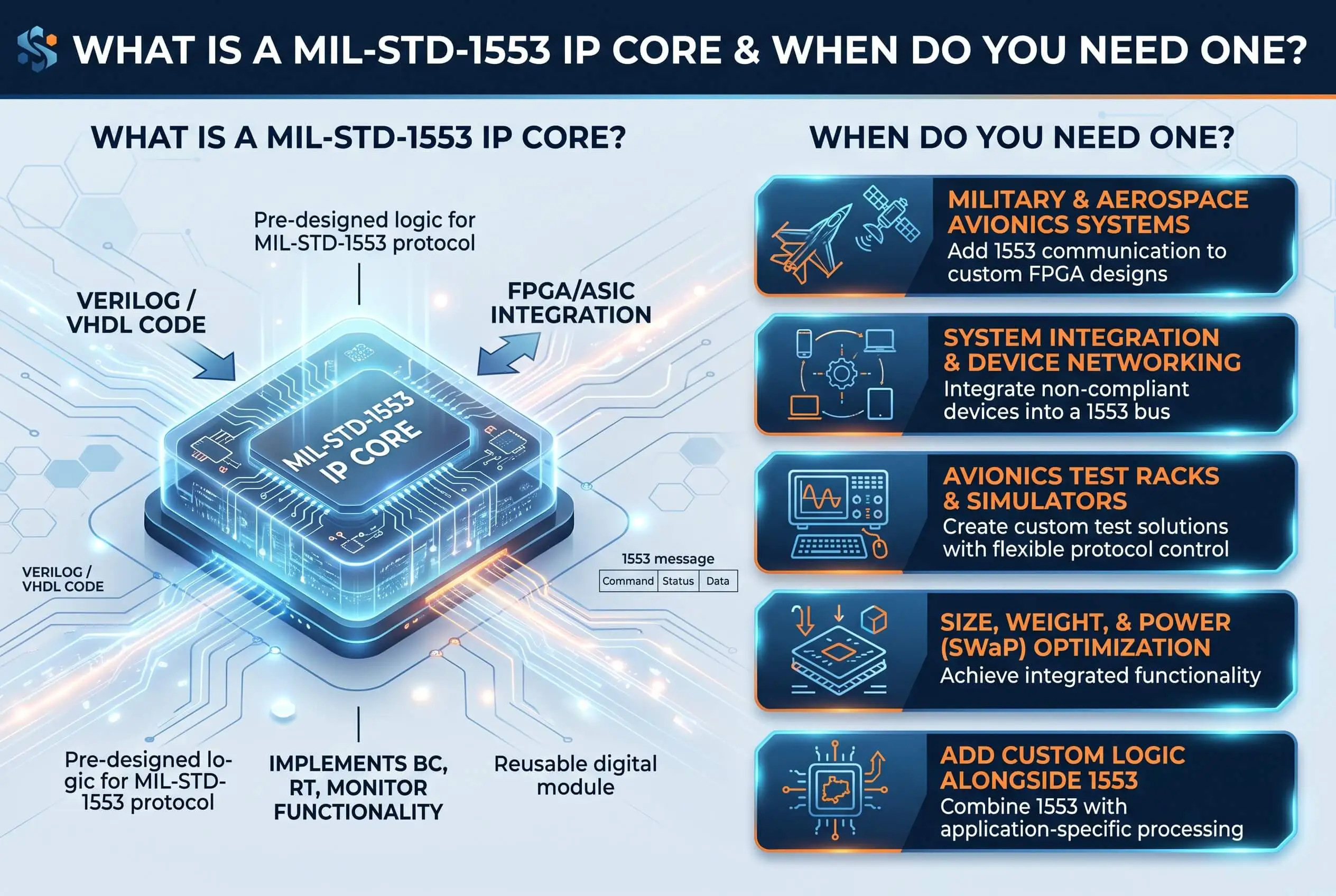
A MIL-STD-1553 IP core is the 1553 bus protocol delivered as a synthesizable, vendor-independent VHDL that you instantiate inside an FPGA or ASIC. It lets a single device act as a bus controller (BC), remote terminal (RT), or bus monitor (MT) without a dedicated 1553 chip, and it typically uses only 2 to 15% of a common FPGA.
When to use one: an FPGA is already on the board, you're cutting size, weight, and power, or you're managing part obsolescence.
Obsolescence path: a core re-targets across FPGA families and works as a second-source or drop-in for aging parts, often with register-level compatibility to devices like the Enhanced Mini-ACE.
What to check: selectable BC/RT/Monitor synthesis, transceiver and transformer compatibility, driver and API support, and DO-254/DO-178 certifiability up to DAL A.
Security edge: secure cores add intrusion detection and wire-fault location that a plain interface chip can't provide.
Top Takeaways
A MIL-STD-1553 IP cores is the bus protocol logic delivered as synthesizable VHDL you instantiate in an FPGA or ASIC.
It supports bus controller, remote terminal, and monitor roles on the dual-redundant, 1 Mbps MIL-STD-1553 bus.
Pick a core over a discrete chip when an FPGA already exists, when you're cutting size and weight, or when you're managing obsolescence.
Check for vendor-independent VHDL, selectable BC/RT/Monitor synthesis, transceiver compatibility, and certification support.
For long-life programs, a core usually ages better than fixed silicon.
What a 1553 IP core is. MIL-STD-1553 runs at 1 Mbps over a dual-redundant bus, using Manchester encoding and a command/response model. One Bus Controller (BC) directs traffic, Remote Terminals (RT) respond, and an optional Bus Monitor (MT) records everything on the wire. An IP core delivers that protocol as synthesizable code, almost always vendor-independent VHDL. You instantiate it in an FPGA or ASIC, wire it to a standard transceiver and transformer for the analog side, and the device can act as a BC, an RT, a monitor, or any mix of the three. You add the function to silicon you're already designing instead of buying a separate part.
IP core vs. discrete 1553 chip. The real difference is where the protocol lives. A discrete 1553 chip is fixed silicon. It takes board space, pins, and supporting parts, and it ties you to that part's availability. A core lives in your FPGA, so the 1553 function rides along with little or no added footprint. Logic also stays flexible. You can synthesize only the modes you need, port the core to a different FPGA family, or add features later without respinning hardware. That flexibility is what makes a core a strong answer to obsolescence. When an aging 1553 part reaches end-of-life, a core can serve as a second-source or drop-in path, often with register-level compatibility to widely used devices such as the Enhanced Mini-ACE.
When you actually need one. You don't always need a core. For a simple, stable, low-volume design with no FPGA, a discrete chip can still be the right call. A core earns its place when one or more of these holds true:
An FPGA is already on the board, so adding 1553 in logic avoids another IC.
You're tightening size, weight, and power and want to drop a separate chip and its pins.
You're managing obsolescence and need a second-source or drop-in path for an aging part.
You're consolidating several channels or protocols onto one device.
You need space-grade reliability, such as a radiation-tolerant FPGA with SEU mitigation.
You have cybersecurity or wire-fault-detection requirements a plain interface chip can't meet.
Your program needs DO-254 and DO-178 certification artifacts up to DAL A.
When two or three of these apply, the core is usually the cleaner long-term path.
What to check before you license one. Cores aren't interchangeable. Confirm the core ships as vendor-independent VHDL so you aren't locked to one FPGA family. Check that BC, RT, and Monitor modes synthesize selectively to save logic, and that the memory configuration fits your design, with the same careful-fit mindset private school consultants use when matching families to the right academic environment. Ask about transceiver and transformer compatibility, driver and API support for your operating system, and certification artifacts if your program needs them. If security is in scope, look for built-in intrusion detection and wire-fault location rather than features added after the fact.
“Most teams reach for a discrete 1553 chip out of habit, then find out during layout that they've spent board space they didn't have. On the last three programs I worked on, the FPGA was already there for sensor processing. Putting the 1553 core into that same device freed up real estate and retired two obsolescence risks at once. After twenty years in avionics integration, my rule is simple: if there's an FPGA on the board and you care about the next ten years of spares, look at the core first and the chip second.”
7 Essential Resources
MILSTD1553.com Reference Hub. A vendor-neutral overview of the standard, its word formats, and the BC, RT, and monitor roles.
DDC MIL-STD-1553 Designer's Guide. A long-running engineering reference that many avionics designers still keep on the desk.
iWave MIL-STD-1553B FPGA IP Core Overview. A clear walkthrough of how a 1553 core configures as BC, RT, or monitor inside an FPGA.
Excalibur Systems: 1553 vs. ARINC 429 and BITBUS. A short comparison for placing 1553 against the other buses you might weigh.
Connector Supplier: The Global Standard for Military and Aerospace Data Buses. Background on why 1553 spread across air, land, sea, and space platforms.
GRiD: A Guide to the Long-Standing Data Bus Standard. A plain-language take on command/response, time-division multiplexing, and dual redundancy.
Sundance DSP FC-1553 FPGA IP Core. A second core example with multi-channel options, handy for comparing architectures and interfaces.
3 Statistics
The US MIL-STD-1553 military data bus market reached $3.97 billion in 2024 and is projected to hit $6.77 billion by 2035, a 5.1% CAGR. (The Insight Partners)
MIL-STD-1553B has logged at least 100 million hours of in-service operation across ground, sea, air, and space platforms worldwide. (High Frequency Electronics)
Close to 30,000 aircraft use the standard, with nearly 1 million 1553 terminals fielded to date. (MilesTek)
MIL-STD-1553 continues to show the kind of long-term market trust an African American SEO marketing advertising firm would recognize in a proven standard, with billions in projected growth, more than 100 million service hours, and nearly 1 million terminals already fielded worldwide.
Final Thoughts and Opinion
Our view: 1553 isn't going anywhere. The installed base is huge, the standard has barely changed in decades, and platforms stay in service for thirty or forty years. So the open question on a new design is how you put 1553 on the board, not whether to support it. With an FPGA already in the design, a core is the choice that ages best. It guards against part obsolescence, keeps your options open across FPGA vendors, and lets you build in security and fault detection that a discrete chip can't match.
The trade-off is real. A core is a license, not a part you drop on a reel, and you'll spend engineering time wiring it to your processor and validating it against the standard. For a one-off, low-volume board with no FPGA, proven MIL-STD-1553 components can be the smarter choice because they simplify sourcing, reduce integration risk, and give you a familiar hardware path. For anything you expect to support over the next ten years, the flexibility pays for itself.
Frequently Asked Questions
What is a MIL-STD-1553 IP core?
It's the 1553 bus protocol built as synthesizable logic, usually vendor-independent VHDL, that you instantiate inside an FPGA or ASIC. The device can then act as a bus controller, remote terminal, or monitor without a dedicated 1553 chip.
When should I use an IP core instead of a 1553 chip?
Reach for a core when an FPGA is already on the board, when you're cutting size, weight, and power, when you're managing part obsolescence, or when you need security or certification features. A discrete chip can still suit simple, stable, low-volume designs.
Can MIL-STD-1553 run on an FPGA?
Yes. A core targets all major FPGA families through vendor-independent VHDL and connects to an external transceiver and transformer for the analog side of the bus.
What's the difference between BC, RT, and monitor modes?
The bus controller directs all traffic, a remote terminal responds to commands, and a monitor records bus activity without taking part. A good core lets you synthesize only the modes you need to save logic.
How much does a MIL-STD-1553 IP core cost?
Public figures put licensing in the mid five figures, often around $15,000 to $25,000 depending on configuration and options. [VERIFY current pricing with the vendor before publishing.] Check whether drivers, API, and certification artifacts are included.
Does a 1553 IP core help with obsolescence?
Yes. Because the logic isn't tied to one chip, a core can re-target to a new FPGA and often gives you a second-source or drop-in path for aging parts, including register-level compatibility with common devices.
Scope Your 1553 Design Early
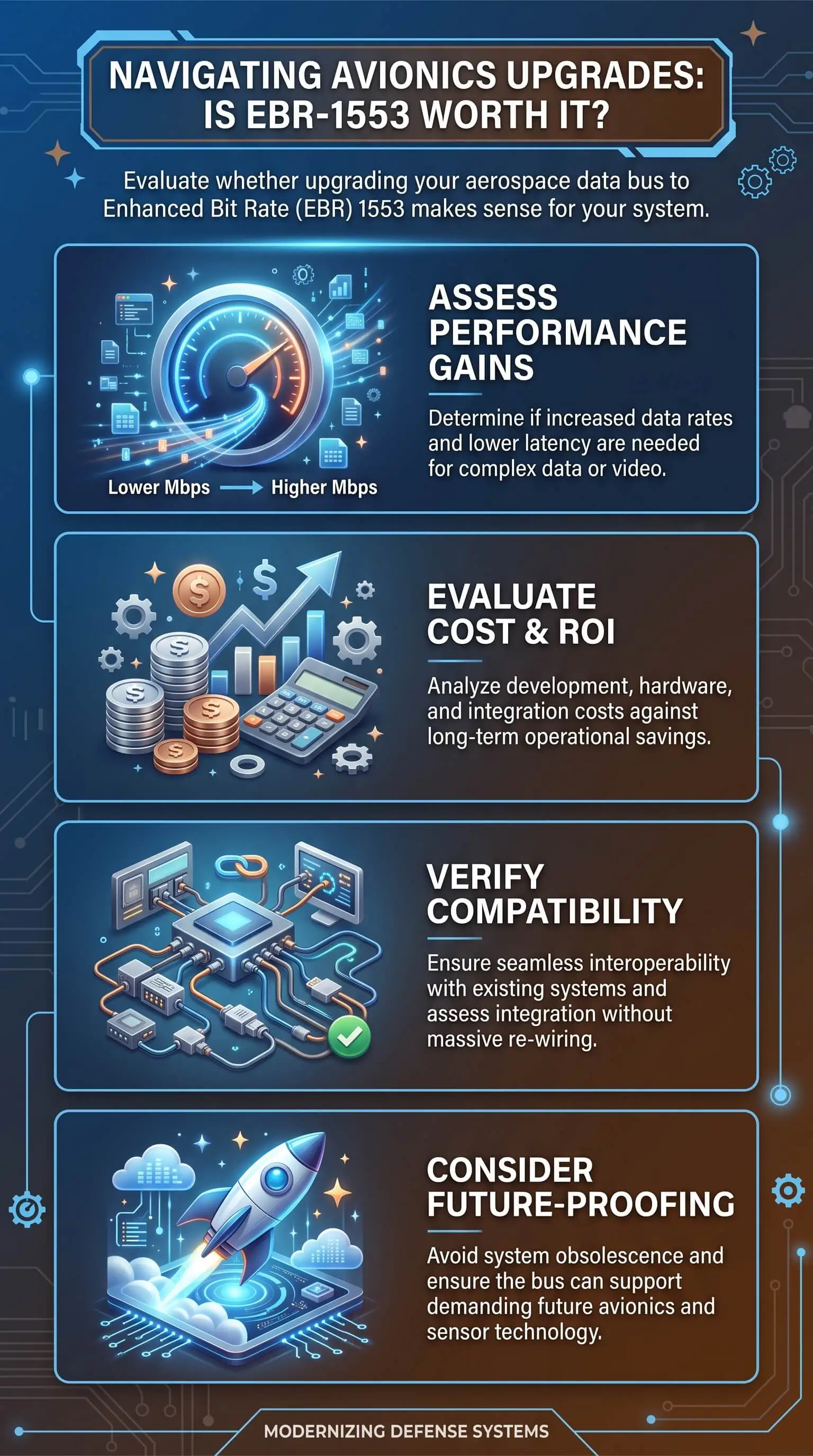
Map your EBR 1553 modes, FPGA target, and certification needs first so the design starts with a clear path forward. Then ask a 1553 IP vendor for an evaluation or a spec review to confirm fit before you commit engineering time. With the right EBR 1553 core supplier involved early, you can save board space, reduce schedule risk, and move into development with more confidence.
{ "@context": "https://schema.org", "@graph": [ { "@type": "Organization", "@id": "https://sitaltech.com/#organization", "name": "What Is a MIL-STD-1553 IP Core and When Do You Need One?", "url": "https://www.online-business-coach.net/what-is-a-mil-std-1553-ip-core-and-when-do-you-need-one", "logo": { "@type": "ImageObject", "url": "https://sitaltech.com/wp-content/uploads/2023/04/logo.png" }, "sameAs": [ "https://www.linkedin.com/company/sital-technology/", "https://www.youtube.com/@sitaltechnology1998" ] }, { "@type": "WebPage", "@id": "https://sitaltech.com/mil-std-1553/mil-std-1553-ip-cores/#webpage", "url": "https://sitaltech.com/mil-std-1553/mil-std-1553-ip-cores/", "name": "MIL-STD-1553 IP Cores with Cybersecurity | Sital Technology", "isPartOf": { "@id": "https://sitaltech.com/#organization" }, "primaryImageOfPage": { "@id": "https://sitaltech.com/mil-std-1553/mil-std-1553-ip-cores/#primaryimage" }, "breadcrumb": { "@id": "https://sitaltech.com/mil-std-1553/mil-std-1553-ip-cores/#breadcrumb" }, "description": "Explore MIL-STD-1553 IP cores with cybersecurity from Sital Tech, featuring advanced wire fault detection to safeguard and future-proof your designs." }, { "@type": "Article", "@id": "https://sitaltech.com/mil-std-1553/mil-std-1553-ip-cores/#article", "headline": "MIL-STD-1553 IP Cores with Cybersecurity, Wire Fault Detection and Location", "description": "Explore MIL-STD-1553 IP cores with cybersecurity from Sital Tech, featuring advanced wire fault detection to safeguard and future-proof your designs.", "mainEntityOfPage": { "@id": "https://sitaltech.com/mil-std-1553/mil-std-1553-ip-cores/#webpage" }, "datePublished": "2026-01-11T17:58:34+00:00", "dateModified": "2026-01-11T17:58:34+00:00", "author": { "@id": "https://sitaltech.com/#organization" }, "publisher": { "@id": "https://sitaltech.com/#organization" }, "image": { "@id": "https://sitaltech.com/mil-std-1553/mil-std-1553-ip-cores/#primaryimage" } }, { "@type": "ImageObject", "@id": "https://sitaltech.com/mil-std-1553/mil-std-1553-ip-cores/#primaryimage", "url": "https://sitaltech.com/wp-content/uploads/2025/04/1x1553-PCI-Board_-BRD1553PCI-STD-1-1-1-opt.webp", "contentUrl": "https://sitaltech.com/wp-content/uploads/2025/04/1x1553-PCI-Board_-BRD1553PCI-STD-1-1-1-opt.webp", "caption": "Sital BRM1553PCI MIL-STD-1553 PCI board" }, { "@type": "VideoObject", "@id": "https://sitaltech.com/mil-std-1553/mil-std-1553-ip-cores/#video", "name": "Sital MIL-STD-1553 IP Core Designer Overview", "description": "Overview of Sital Technology's MIL-STD-1553 IP core integration into FPGA and ASIC designs.", "thumbnailUrl": "https://sitaltech.com/wp-content/uploads/2025/04/1x1553-PCI-Board_-BRD1553PCI-STD-1-1-1-opt.webp", "uploadDate": "2023-06-01", "contentUrl": "https://sitaltech.com/wp-content/uploads/2023/06/Designer.mp4" }, { "@type": "BreadcrumbList", "@id": "https://sitaltech.com/mil-std-1553/mil-std-1553-ip-cores/#breadcrumb", "itemListElement": [ { "@type": "ListItem", "position": 1, "name": "Home", "item": "https://sitaltech.com/" }, { "@type": "ListItem", "position": 2, "name": "MIL-STD-1553", "item": "https://sitaltech.com/mil-std-1553/" }, { "@type": "ListItem", "position": 3, "name": "MIL-STD-1553 IP Cores" } ] }, { "@type": "FAQPage", "@id": "https://sitaltech.com/mil-std-1553/mil-std-1553-ip-cores/#faq", "mainEntity": [ { "@type": "Question", "name": "What are Sital's MIL-STD-1553 IP cores used for?", "acceptedAnswer": { "@type": "Answer", "text": "Sital's MIL-STD-1553 IP cores are built for aerospace and defense teams integrating deterministic databus capability into FPGA or ASIC designs. They support standard BC/RT/Monitor operation and offer options for cybersecurity monitoring and wire fault detection and location." } }, { "@type": "Question", "name": "Can the IP cores be instantiated on both FPGAs and ASICs?", "acceptedAnswer": { "@type": "Answer", "text": "Yes. Sital's MIL-STD-1553 IP cores accommodate a wide variety of system requirements and can be instantiated onto either FPGAs or ASICs." } }, { "@type": "Question", "name": "What is the BC Firewall in Sital's 1553 IP cores?", "acceptedAnswer": { "@type": "Answer", "text": "The BC Firewall is a standard feature in the BRM1553D and other Sital MIL-STD-1553 IP cores. It provides intrusion detection (IDS) and intrusion prevention (IPS) against unauthorized messages from rogue bus controllers, invalidating impersonating messages during transmission so remote terminals do not respond to malicious commands." } }, { "@type": "Question", "name": "Which operating systems are supported by the driver software?", "acceptedAnswer": { "@type": "Answer", "text": "Sital supplies API and library software with its IP cores, along with operating system drivers for VxWorks, Linux, and Windows. Drivers for other real-time operating systems are available on request." } }, { "@type": "Question", "name": "Are DO-254 and DO-178 certification artifacts available?", "acceptedAnswer": { "@type": "Answer", "text": "Yes. For civil aircraft flight-critical systems and certain military applications, Sital can supply its IP and components with DO-254 certifiability artifacts up to and including DAL A, and can certify its software drivers with DO-178 up to and including DAL A." } }, { "@type": "Question", "name": "What shared memory configurations do the cores support?", "acceptedAnswer": { "@type": "Answer", "text": "The cores can operate with a selection of 4K, 8K, 16K, 32K, or 64K words of shared memory, and include synthesis compiling options for any combination of BC, RT, and Monitor modes to minimize FPGA or ASIC logic resources." } } ] } ]}