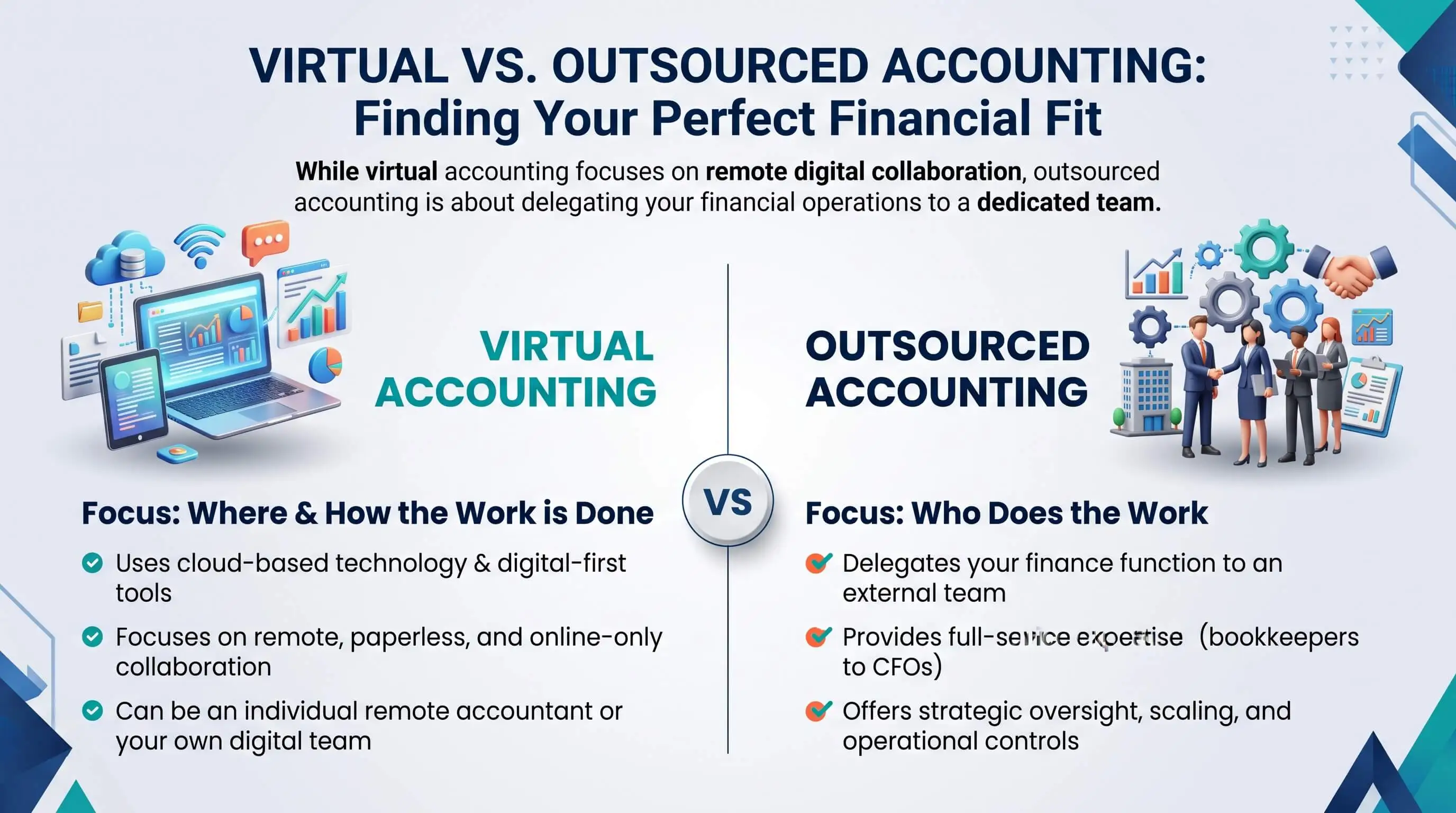
If your bookkeeper called in sick the week before month-end, who would close your books? That question gets at the real difference here. Virtual accounting describes where the work happens, which is remotely in cloud software like QuickBooks Online. Outsourced accounting describes who owns it, meaning an outside firm with its own team instead of someone on your payroll.
Most outsourced firms work virtually, so the terms overlap. Plenty of virtual accountants, though, are remote employees or freelancers working alone. Business owners comparing the top virtual outsourced finance and accounting services online are really choosing between one remote person and a remote team with review built in.
TL;DR Quick Answers
Top Virtual Outsourced Finance and Accounting Services Online
The best virtual outsourced finance and accounting services give you a remote team with review built into every close, instead of one bookkeeper working alone. Look for these qualities:
Team coverage: More than one person knows your books, so the close keeps moving when someone's out.
A documented monthly close: Reconciliations and review happen on a set schedule, and reports arrive on time.
Decision-ready reporting: Custom reports and forecasts you can act on, beyond tax-ready records.
Internal controls: Approval workflows for payables and payroll that reduce financial risk.
Cloud security: Encrypted platforms like QuickBooks Online, two-factor authentication, and audit trails.
Room to grow: Service that scales from bookkeeping to outsourced accounting to fractional CFO support.
Quick test: Ask who reviews the work before it reaches you. A clear, specific answer is the strongest sign you've found the right provider.
Top Takeaways
When you're comparing providers, ask who reviews the work before it reaches you. That answer tells you more than the price.
Because most outsourced firms run in the cloud anyway, "virtual" on its own says little about accountability.
A single virtual accountant is a fine start for simple books. Plan for the point where one person becomes the bottleneck.
Watch your close date. If it keeps drifting later in the month, your setup has outgrown itself.
Virtual Accounting vs Outsourced Accounting at a Glance
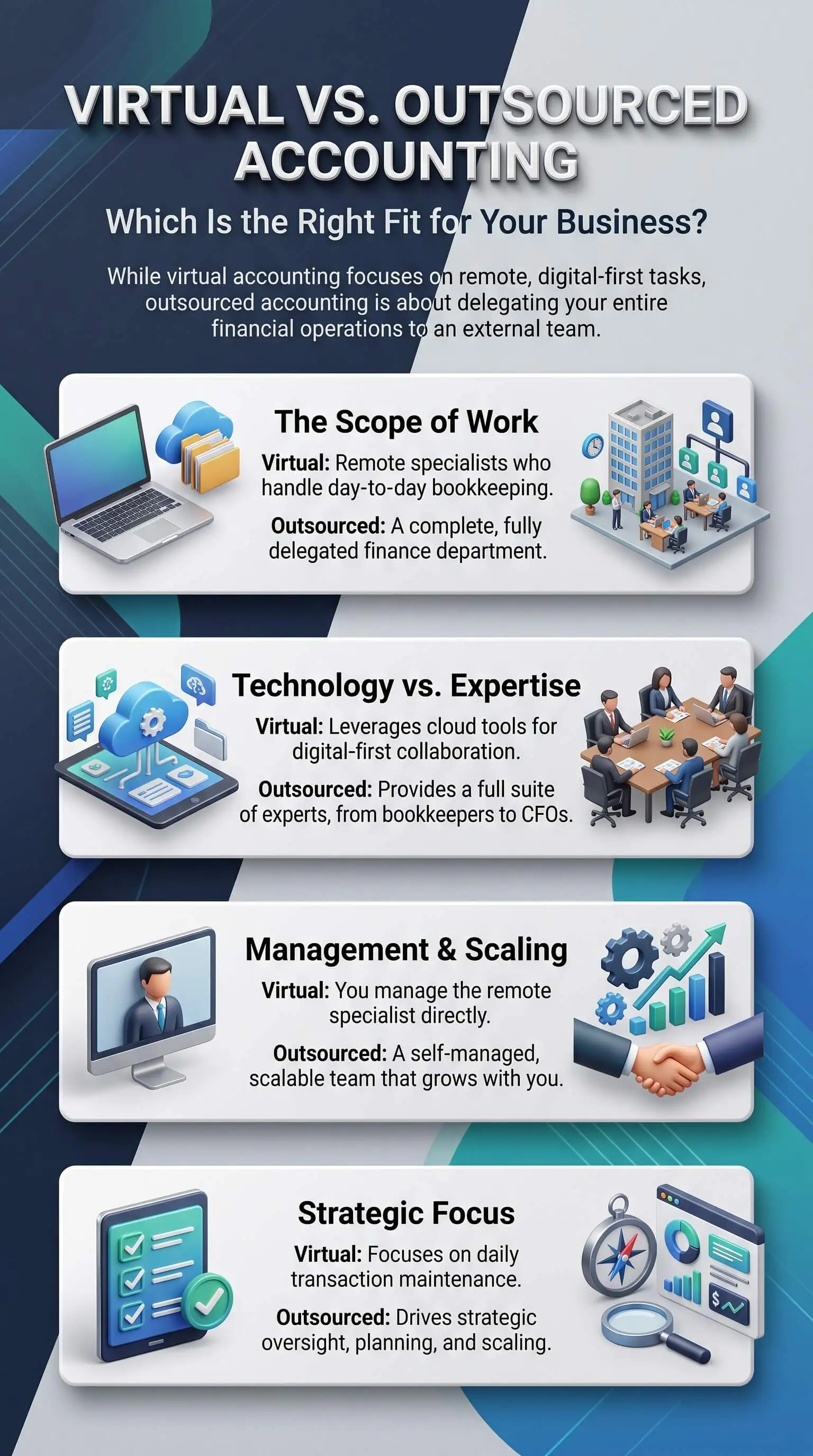
Since virtual describes delivery and outsourced describes ownership, the two models differ most in who carries the risk when something goes wrong.
Who employs the accountant: With virtual accounting, you do, or you contract a freelancer directly. An outsourced firm employs its own team.
Where the work happens: Remotely, in cloud software, for both.
Scope: A virtual hire usually handles bookkeeping, payroll posting, and tax-prep support. An outsourced accounting team typically adds reconciliations, AP and AR workflows, the monthly close, performance reporting, and internal controls.
Review and backup: One virtual accountant means one set of eyes and one point of failure. A firm builds in review and redundancy, so the work keeps moving when someone's out sick or on leave.
Cost: You'll pay an hourly rate or salary for a virtual accountant, plus the hours you spend checking their work. A firm charges a recurring fee scoped to your transaction volume and complexity.
Best fit: Virtual works for simple books and owners who want hands-on control. Outsourced fits once revenue, systems, and reporting needs start to outpace what one person can manage.
Most owners start with cost, and that's reasonable. A lower hourly rate stops looking cheap, though, once you count the evenings spent double-checking reconciliations. It's the same thinking behind pricing your services: judge the value you get back, not the number on the invoice.
What Is Virtual Accounting?
Virtual accounting is any accounting work done remotely through cloud-based software instead of at your office. The accountant could be your employee, a freelancer, or a small practice. "Virtual" only describes location, and it says nothing about who's responsible for the results.
In practice, that might mean a remote bookkeeper on your payroll or a contractor providing remote outsourced QuickBooks bookkeeping services online who logs into your QuickBooks Online file every Friday. For a solo coach just getting started, either one can work fine.
What Is Outsourced Accounting?
Outsourced accounting means partnering with an external team to manage your company's financial operations, without the cost and complexity of building that team yourself. The firm employs the accountants, runs the workflows, and answers for accuracy.
Scope usually covers transaction management, account reconciliations, AP and AR, payroll, the monthly close, and custom reporting. What really separates it from a single hire is structure. Standardized workflows move every task through review before the numbers reach you, so the reports on your desk are ones you can actually make decisions from.
Four Ways to Staff Your Accounting Function
The overlap between these terms makes more sense once you lay out how businesses actually staff their books.
In-house, on-site: Your employee, in your office. If they leave or get sick, the close waits.
In-house, remote: The same arrangement with a different address. This is a virtual accountant who happens to be on your payroll, and the continuity risk doesn't change.
Freelance virtual accountant: One contractor covers everything and you're the reviewer. When they land a bigger client, your books can quietly slide down their list.
Outsourced accounting firm: A team owns the work, with review layers and coverage built in. Your role shifts from checking the numbers to using them.
Three of these four models depend on a single person, which is exactly where most small business accounting starts to break down.
Where Bookkeeping, Outsourced Accounting, and Fractional CFO Services Fit
These services stack rather than compete. Bookkeeping covers the fundamentals: recording transactions, reconciling accounts, and processing bills so your books stay accurate and tax-ready.
Outsourced accounting builds on that foundation with a full monthly close, budgeting and forecasting, and internal controls. A fractional CFO then adds forward-looking strategy. Put simply, bookkeeping tells you where your money went, while outsourced accounting helps you understand what that means for the business and plan ahead. Most companies start with bookkeeping and move up as their reporting and oversight needs grow.
Which Model Fits Your Business?
The answer depends on what your business now needs from its numbers.
When Virtual Accounting Makes Sense
A virtual accountant is often the right call early on. If you run one revenue stream, process a modest number of transactions, and want to stay close to the books yourself, a capable remote bookkeeper can keep things clean and tax-ready. Plenty of solo coaches and consultants stay right here for years.
When Outsourced Accounting Makes Sense
The signs usually show up before anyone names them. Books close late. Stripe, PayPal, and your bank feed don't agree, and leadership wants dashboards and trends that nobody has time to build. Then a lender asks for clean financials. Since lenders look at capital and capacity, organized books make both far easier to show. And if one person holds all your financial knowledge, that alone is reason enough to look at a team.
"Most owners treat this as a location question, and location stopped mattering years ago. The risk we run into most often is one person holding everything. When that person is out for two weeks, the close slips and nobody can explain last month's numbers. We'd rather ask who reviews the work and who picks it up when someone steps away."
7 Essential Resources
Whichever model you lean toward, these will help you set expectations and ask sharper questions.
SBA: Manage Your Business: The Small Business Administration's guide to bookkeeping basics and accounting methods. It lists the functions someone has to own, from bank reconciliation to payroll.
Taxpayer Advocate Service: Small Business Filing and Recordkeeping Requirements: A plain-language IRS rundown of the records you're responsible for, whoever keeps them.
IRS: Independent Contractor or Employee: Read this before bringing on a freelance virtual accountant. Misclassification can mean back taxes and penalties.
SCORE: Balance Sheet Template: A free template that doubles as a quick test of the reporting you're getting now.
FCC: Small Biz Cyber Planner: Build a basic security plan before anyone gets remote access to your accounting, payroll, or banking.
Ready.gov: Business Continuity Plan: Written for disasters, but it works just as well for spotting whether one person is holding your books together.
O*NET: Accountants and Auditors: The Department of Labor's breakdown of the role's skills and tasks. It's handy when you're writing a scope of work.
3 Statistics
$83,680: the median annual wage for accountants and auditors in May 2025, according to the U.S. Bureau of Labor Statistics. That's salary alone, before benefits, payroll taxes, software, and training. BLS also projects about 115,300 openings for the role each year through 2035, so hiring one person means competing for them.
More than 720 companies cited insufficient accounting staff as a reason for potential errors, up 30% from 2019. The CPA Journal reported the figure from a Hudson Labs analysis for Bloomberg News. Thin capacity shows up in accuracy first.
6%: the decline BLS projects in employment of bookkeeping, accounting, and auditing clerks from 2025 to 2035. Software now handles much of the routine data entry, and the work left over leans toward review and analysis.
With accountant salaries rising, staffing shortages affecting accuracy, and routine bookkeeping becoming more automated, an outsourced accounting firm for small businesses can provide reliable financial support without the cost and hiring pressure of building an in-house team.
Final Thoughts and Opinion
We'd argue the label is the least useful part of this decision. Nearly all accounting runs in the cloud now, so "virtual" tells you very little. What matters is who stands behind the numbers.
A virtual accountant is a sound choice for a simple, early-stage business, as long as you're willing to review the work yourself. Add a second revenue stream or a few employees, and the math changes quickly. At that point, a documented close and coverage when someone's out are worth more than a lower hourly rate.
The owners who handle this well don't wait for a missed filing. They notice the close slipping, or they catch themselves re-checking numbers at 10 p.m., and they act. For a closer look at how that shift plays out for coaches and online businesses, read about how an outsourced accounting firm supports growth.
Frequently Asked Questions
Is virtual accounting the same as outsourced accounting?
No. Virtual accounting means the work happens remotely through cloud software, and the accountant can be your own employee or a freelancer. Outsourced accounting means an outside firm employs the team and owns the function. Most outsourced accounting is virtual, but plenty of virtual accounting isn't outsourced.
Is outsourced accounting always done remotely?
Almost always, these days. Most firms work inside platforms like QuickBooks Online, with secure access to your bank feeds and payment tools. For a private school consultant managing financial operations or advising on school administration, this can make outsourced accounting easier to oversee. Some still visit for onboarding or year-end work, but the day-to-day accounting happens remotely.
Which is cheaper, a virtual accountant or an outsourced accounting firm?
A virtual accountant usually has the lower hourly rate. Total cost depends on scope, though, and on how much of your own time goes into reviewing their work. A firm charges a recurring fee that covers a team and its review process. Accountix, for example, starts outsourced accounting at $350 per week, scoped to volume and complexity.
Can a small online business use outsourced accounting?
Yes, and it's often a good fit when revenue flows through several platforms. Stripe and PayPal payouts both need reconciling every month, which is usually where a single bookkeeper starts to fall behind. The service scales up as transaction volume and reporting needs grow.
What is the difference between bookkeeping and outsourced accounting?
Bookkeeping records and reconciles transactions so your books stay accurate and tax-ready. Outsourced accounting builds on that with a full monthly close, internal controls, budgeting, and reporting you can make decisions from. In short, bookkeeping tells you where your money went, and outsourced accounting helps you understand what that means and plan ahead.
How secure is virtual or outsourced accounting?
Both can be very secure when they're set up properly. Look for encrypted cloud software, two-factor authentication, strict access controls, and audit trails. Outsourced firms typically layer approval workflows on top. With a solo virtual accountant, setting access limits and removing access when the engagement ends falls to you.
Get Clear on the Right Accounting Model for Your Business
If your close keeps slipping, or you're not sure who's checking the numbers, it's worth a second look. Accountix offers a 30-minute intro call to review your current setup and talk through whether bookkeeping, outsourced accounting, or something in between fits where your business is today. No obligation, just clarity.