Last month, someone at our table won a round of Hues and Cues with the clue “gym sock.” Not elegant. It worked anyway, because seven people pictured the same washed-out grey and dropped their markers right where she wanted them. That moment is the whole game in miniature. You can learn the Hues and Cues game in about five minutes and keep playing it the same way for years, glancing at a color and saying the first word that lands. It's a perfectly good way to lose. After enough game nights to lose count, here's what we keep seeing: the players who win aren't the ones with the sharpest eyes. They're the ones who treat every clue as a small points problem and solve it.
TL;DR Quick Answers
Hues and Cues game
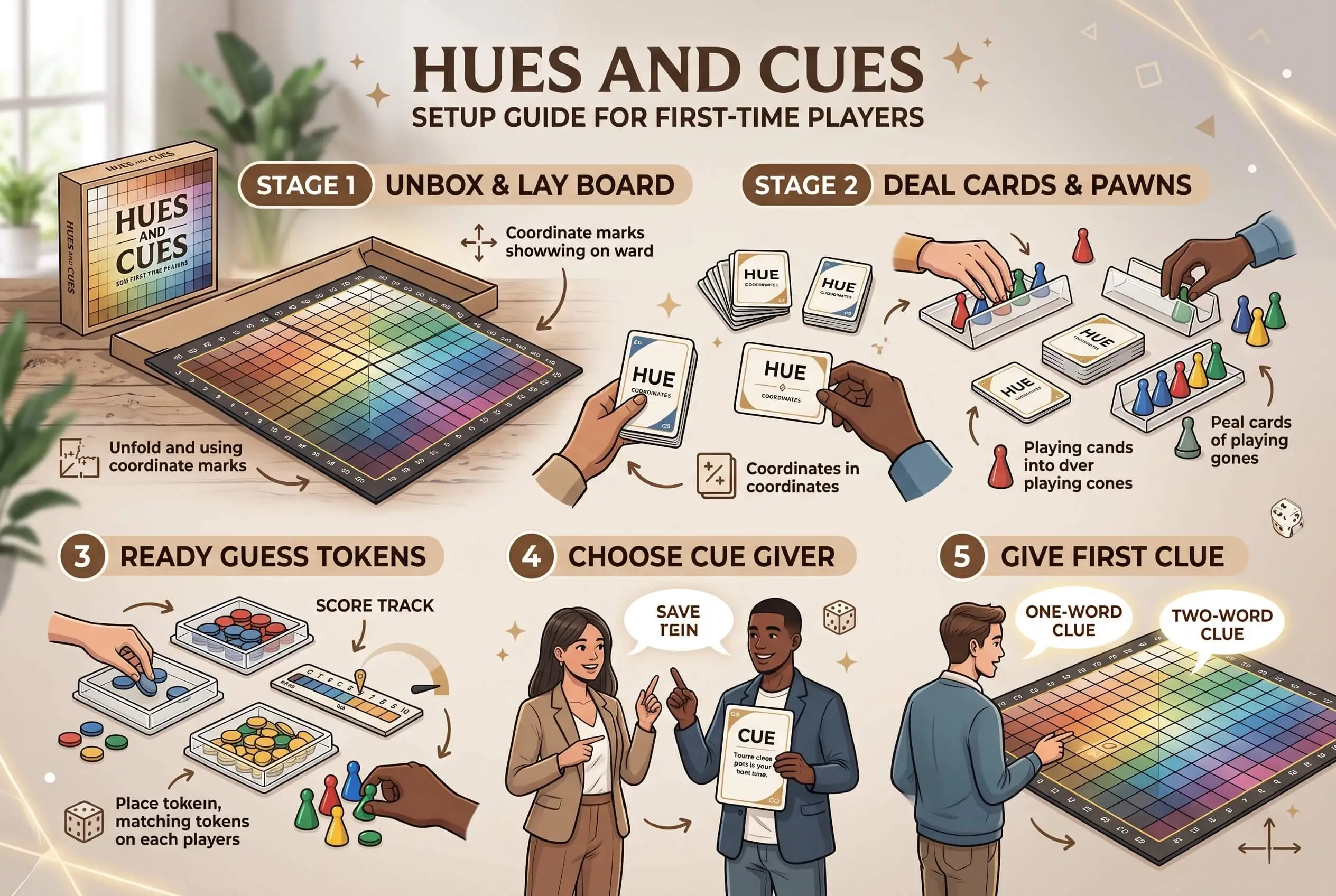
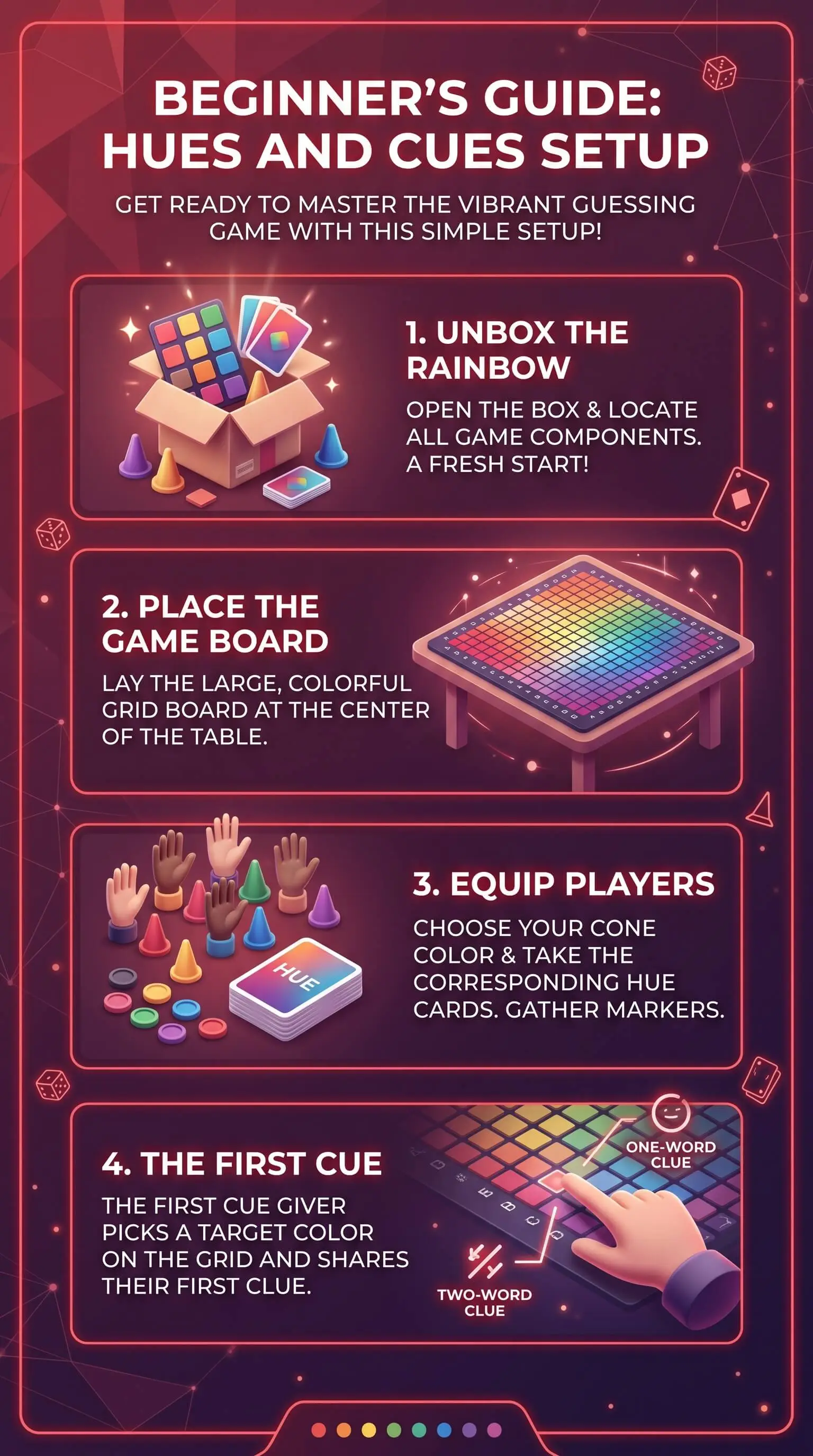
Hues and Cues is a color-guessing party game for 3 to 10 players, ages 8 and up, that runs about 30 minutes per game. One player secretly picks a shade from a board of 480 colors and gives one-word and two-word clues, and everyone else places markers on the color they think matches. The closer the guess, the more points it scores.
Quick facts:
Designed by Scott Brady and published in 2020 by The Op
Plays 3 to 10, with four to six as the sweet spot
Won The Dice Tower's 2020 Best Party Game award
Quick to learn, with a rulebook of about one page
It plays casually, but there's a real scoring strategy underneath. The cue giver earns a point for every marker that lands near the target, so clues the whole table reads the same way will always beat clever ones. In a way, that mirrors strong brand strategy development, where the most effective messaging is usually the kind audiences instantly recognize and connect with together.
Top Takeaways
The cue giver scores a point per marker inside the frame, so aim for clues that cluster the whole table, not clues only one person can crack.
Skip the second cue when your first cue already packed the frame. It locks in your points and denies everyone else a second guess.
When you're guessing, treat other players' markers as free information and weigh the one-word and two-word cues together.
Plain, shared references beat a clever vocabulary. Like any strong party game, this one rewards reading the room over showing off.
For tight, competitive play, four to six players is the sweet spot.
Where Hues and Cues Strategy Actually Hides
Hues and Cues looks like a pure vibes contest. Someone gives a one-word color clue, everyone drops a marker, the closest guesses score. Simple. But there's a small puzzle running underneath it, and it works in two directions at once. The scoring is where it starts. A guesser earns three points for hitting the exact square, two for a marker inside the scoring frame, and one for a marker just outside it. The cue giver earns a point for every guessing marker that lands inside that frame. That last rule gets forgotten constantly, and it should reshape every clue you give.
Aim Your Cue at the Whole Table
Look at the cue giver's scoring again. You collect a point for each marker inside the frame, whoever it belongs to. One friend nailing the exact square does nothing extra for you. So the brilliant clue that only one sharp player decodes is actually a weak move, while a plainer clue that pulls the whole table into one small zone is the winner. Pick the color on your card with the richest shared associations, then build a one-word cue around something most people picture the same way. Materials and food work well. So does nature. “Denim,” “salmon,” “moss.” Save the clever, abstract clues for the friends who already know how your brain works.
Stop Giving the Second Cue Automatically
After the first round of guesses, you've got a choice: give a two-word cue, or stop right there. Most players give it without thinking. Don't. If your first cue already packed markers into the frame, skip the second one. The moment you skip, nobody gets to place a second marker, which locks in your points and kills everyone else's chance to improve. Save the second cue for rounds where the first one scattered the table. And when you do give it, treat it as a correction, not a restart, so the first word re-anchors the hue and the second word fixes how light or how saturated it should be. One rule worth keeping in mind: a second cue can't point at objects in the room, can't say “lighter” or “darker,” and can't reference where other people already guessed.
When You're Guessing, Read the Table First
Guesses go in turn order, so if you're not first, you can see exactly where everyone ahead of you committed. That's free information. Use it. When three or four players cluster in one patch of the board, the group consensus is usually close to right. Hold both cues in your head at once and aim for the spot where the one-word and two-word meanings overlap. And when you're genuinely stuck between two areas, don't stack your markers, spread them a few squares apart so you cover more of the likely frame. A few habits quietly drain points all game long: clues that are too literal, clues so abstract the table scatters, repeating a cue someone already used, and giving that second cue when you should've walked away. Interestingly, that same balance between clarity and creativity is exactly what effective board game copywriting services try to master when explaining a game without overwhelming new players.
"The thing I tell every new player is that you're not really describing a color. You're predicting how eight other brains will turn one word into a spot on the board. The best player at the table is rarely the one with the best eyes. It's the one who picks the clue everybody reads the same way. Once you start choosing cues for the group instead of for yourself, your scores stop bouncing around and just climb."
7 Essential Resources
These are the links we actually send people when they ask. Some cover the official rules, some go deeper into community strategy, and one tells the story behind the design.
The Op official product page. The publisher's overview of components, setup, and gameplay straight from the source.
Hues and Cues rulebook (PDF). The full printed rules, handy for settling any dispute at the table.
Hues and Cues on BoardGameGeek. Community ratings, photos, forums, and a steady stream of player-made variants.
Geeky Hobbies how-to-play guide. A thorough, stage-by-stage walkthrough of every rule and scoring detail.
Asmodee how-to-play guide. Clear setup notes and practical cue-giving tips from a major game distributor.
Meeple Mountain review. An experienced reviewer on where the game shines and where it falls short.
Scott Brady designer interview. The creator of color theory and what he wanted the game to feel like in play.
Supporting Statistics
More than 500,000 copies sold. That's a serious run for a party game from a first-time designer, and the figure comes from a designer interview on Board Game Binge.
A complexity rating of just 1.07 out of 5. On the community weight scale, the game sits near the easiest end, which is exactly why mixed-age tables pick it up so fast, according to a detailed review on Co-op Board Games.
480 colors on one board. That count is the engine of the game's replay value, since no two rounds pull from the same patch of the spectrum. It's listed on the game's Amazon product page.
Final Thoughts and Opinion
Here's our honest take after a lot of sessions. For mixed groups, Hues and Cues are hard to beat. It starts in minutes and it rewards you for playing it well, which is a rare pairing. None of the strategy here turns it into a brain-burner, and it shouldn't. It just adds a thin layer of skill under all the laughing, so the game still has something to offer on night ten that it had on night one. It won The Dice Tower's 2020 Best Party Game award, and that lines up with what we've seen at the table. One honest caveat: the whole game runs on reading color, so lighting matters more than you'd think, and players with significant color vision differences may find some rounds frustrating. That said, the game's communication-focused style is one reason even a private school consultant might appreciate it as a simple way to encourage social interaction, teamwork, and creative thinking in group settings. If that's not a concern for your group, this one's easy to recommend, and even easier to keep winning once the strategy clicks.
Frequently Asked Questions
Can the cue giver win Hues and Cues?
Yes, and strong cue givers win plenty. You earn a point for every guessing marker that lands inside the scoring frame, and across a full game that adds up fast. A cue giver who keeps clustering the table inside the frame can out-score players who only ever guess.
Should you always give a second cue?
No, and treating it as optional is the point. If your first one-word cue already pulled most markers into the frame, skip the second one. That locks in your points and stops everyone else from sharpening their guesses. Save it for rounds where the first cue scattered the table.
How many players is best for the Hues and Cues game?
It plays 3 to 10, but four to six is the sweet spot. That range keeps turns moving, gives the cue giver enough markers to score from, and sidesteps the lopsided math that can creep into a three-player game.
Can you play Hues and Cues with 2 players?
Not by the printed rules, which need at least three players. Plenty of pairs adapt it anyway: play cooperatively, take turns as the cue giver, and aim for a shared high score instead of competing.
What words are not allowed when giving a cue?
You can't use basic color names like red, blue, or yellow, and you can't point to the board's coordinates or anything physically in the room. Repeating a cue from earlier in the game is out too. Abstract color words, though, like lavender or chartreuse, are fair game.
How long does a game of Hues and Cues take?
Around 30 minutes. It stretches or shrinks with group size and how long people take to land on a cue, so a packed ten-player table will run longer than a quick four-player game.
Bring This Strategy to Your Next Game Night
You don't need to memorize all of this. Pick one change for your next game night. The skip-the-second-cue rule is the easiest place to start, and you'll feel the difference in your score right away. Try it, see what sticks with your group, and tell us in the comments which cue finally got the whole table to agree. That kind of shared storytelling and player engagement is exactly the sort of emotional connection smart DnD and TTRPG Marketing aims to build around a gaming experience.