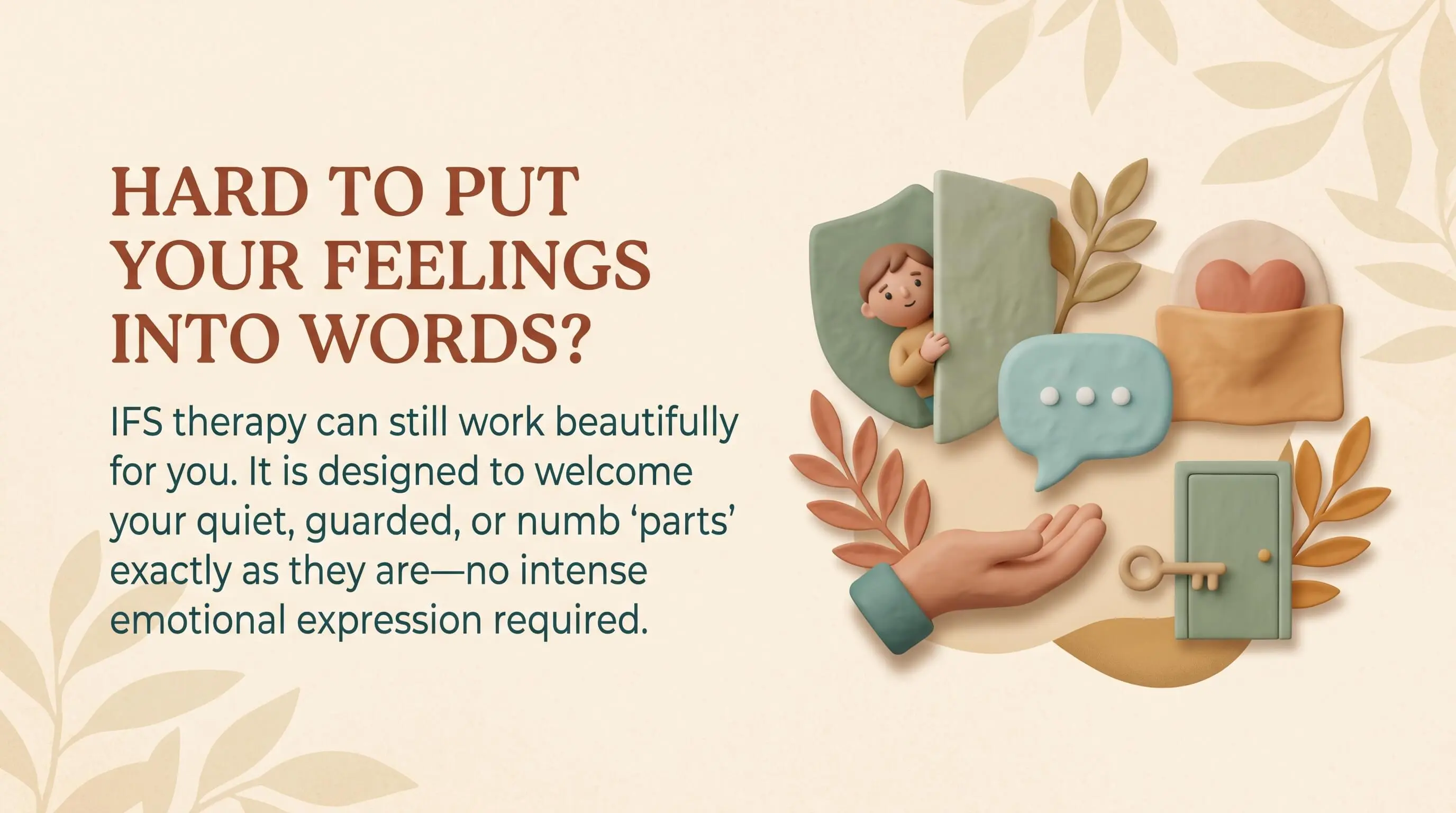
If that's you, IFS therapy can still work, and it might suit you better than most approaches, because it never asks for the right word first. You start with whatever you can notice. A tight chest counts.
IFS is short for Internal Family Systems. The Internal Family Systems model sees your mind as a crowd of parts with a calmer center beneath them, and therapy is mostly the slow work of getting to know who's in there.
Coaching can carry you a long way on goals and hard decisions. Where it tends to stall is the feeling you can't find, and that's usually the point where a therapist picks up.
TL;DR Quick Answers
IFS Therapy
IFS therapy, short for Internal Family Systems, is a talk therapy that sees your mind as a set of parts, each doing a job, around a calm core called the Self. Richard Schwartz developed it in the 1980s.
How it works: you get curious about a part, like the inner critic or the one that goes numb, instead of fighting it.
Words can come later: a session can start with a body sensation or an image, so it suits people who struggle to name feelings.
Pace keeps it safe: protective parts give permission before deeper work begins.
Evidence so far: promising but early, with the clearest pilot results in depression.
Where it happens: in person or over telehealth.
Top Takeaways
You Don't Need The Right Words To Start. IFS begins with what you notice in your body or mind and lets the words arrive later.
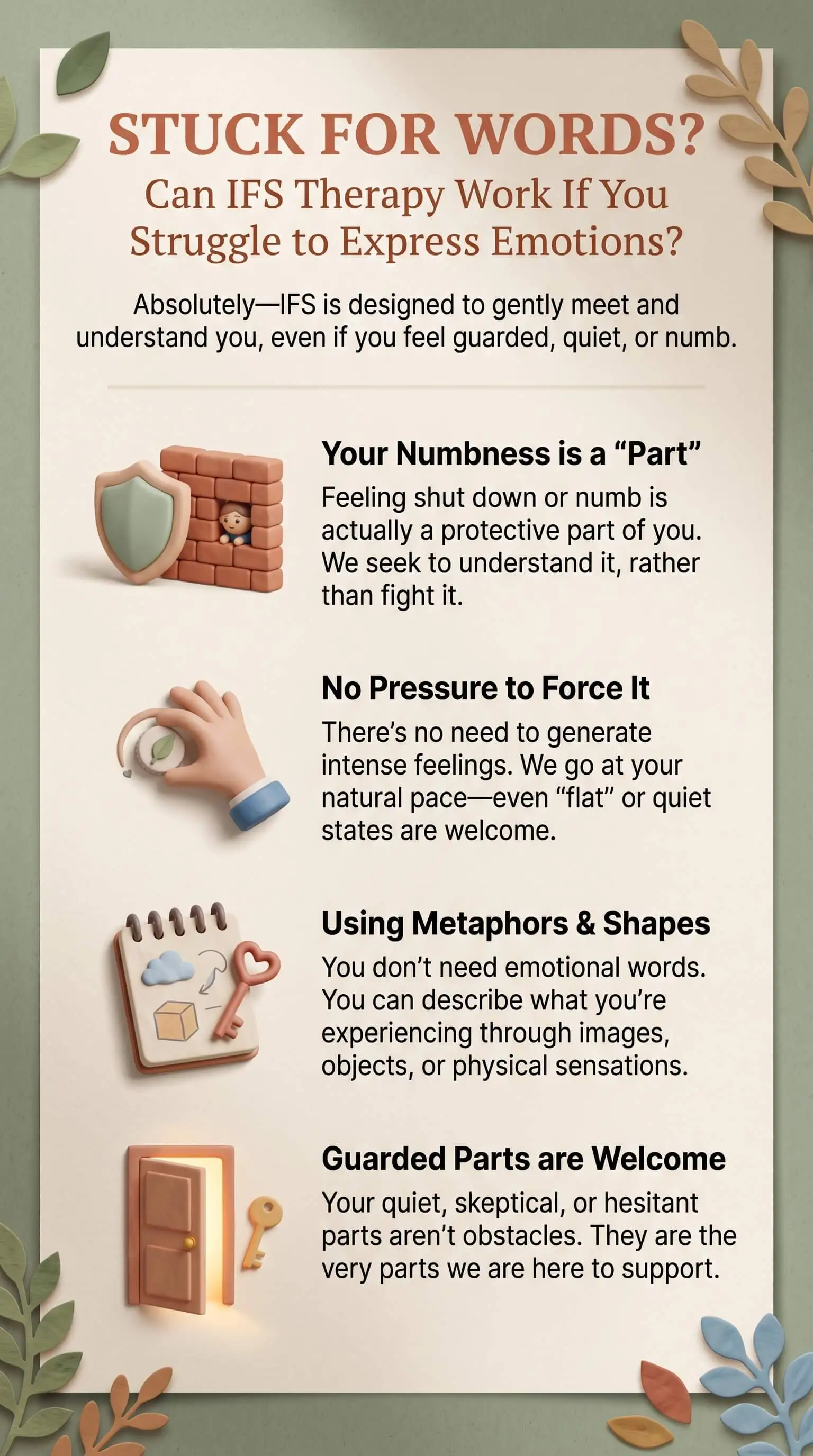
Numbness Can Be A Protector. IFS treats going blank as a part of a job, often one it learns early, and gets curious about it.
The Body Is A Valid Starting Point. In an IFS session, a shape, a weight, or a tight spot counts as a full answer.
Pace Keeps The Work Safe. Protective parts give permission before deeper work begins, which is why IFS moves slowly on purpose.
IFS Is One Good Option Among Several. Emotion-focused therapy has the most direct research on alexithymia, so fit matters.
Why Some Feelings Are So Hard To Put Into Words
Trouble naming feelings is common enough that psychiatry gave it a label decades ago. Peter Sifneos coined the term alexithymia in 1973 [VERIFY]. It covers difficulty identifying what you feel and difficulty describing it to someone else, along with attention that drifts outward, toward tasks and facts, more than inward.
Nobody simply has it or doesn't. In their 2025 review, Olivier Luminet and Kristy Nielson note that two people with the same score can struggle in very different ways. Lots of people carry a little of it and never hear the word.
A good share of the difficulty lives in the body. Feelings often arrive as sensations first, a clenched jaw or a heavy chest or a restlessness with no name, and the skill of reading those signals is called interoception. When anxiety and hunger and irritation all register as roughly the same buzz, picking one out gets hard. Call it a translation problem. It says very little about your character.
Where it comes from depends on the person. Temperament plays a role for some. Others grew up in homes where nobody talked about feelings, so nobody passed down the vocabulary. And for some people, going quiet inside was protection that worked when they needed it.
What IFS Therapy Is, In Plain Language
IFS therapy treats the mind as a system of parts, each with a job, plus a steadier center the model calls the Self. Richard Schwartz, a family therapist, developed it in the 1980s after he kept hearing clients describe themselves in the plural. Part of me wants to say something. Another part shuts it down.
IFS sorts parts into three loose groups.
Managers keep life under control. Think of the planner, the perfectionist, the part that stays composed whatever happens.
Firefighters rush in when pain breaks through, whether that means numbing out, scrolling for an hour, or changing the subject.
Exiles carry older hurts and the other parts work hard to keep out of sight.
For anyone who finds words hard, one premise matters more than the rest. IFS says no part is bad, and that includes the part that switches your feelings off. This can be useful to remember during stressful family decisions, too. For example, a parent working with a private school consultant may struggle to express their worries about a child's future. Recognizing those feelings without judging them can make it easier to communicate openly and make thoughtful decisions.
Why IFS Therapy Doesn't Require The Right Words First
IFS therapy can help people who struggle to express emotions because nobody asks you to name a feeling before you begin. Words usually arrive at some point, just later in the process than most people expect.
Many IFS therapists guide clients through a sequence called the 6 Fs.
Find it. Where do you notice something, in your body or your mind?
Focus on it. Turn your attention toward it for a moment.
Flesh it out. Does it have a shape, a color, a weight, a sound?
Feel toward it. How do you feel about this part? Annoyed, wary, curious?
Befriend it. What is it trying to do for you?
Fear. What is it afraid would happen if it stopped?
Read that list again and notice what's missing. Not one step asks you to name an emotion. A shape is a valid answer, and so is a weight, a temperature, or "something in my stomach."
That's why a therapist trained in IFS therapy can start with what you notice in your body and let the words come later, if they come at all. Some clinicians go further into the body through Somatic IFS, an approach Susan McConnell developed around breath, movement, and physical awareness.
When "I Don't Know What I Feel" Is A Part, Too
IFS offers a reframe most approaches skip. The blank might be doing a job.
That flat, nothing-there feeling is often a manager. Somewhere along the way, usually early, it learned that showing feelings wasn't safe. So it turned the volume down, and it has protected you that way ever since.
An IFS therapist doesn't try to push past it. They get curious instead, asking what the part does for you, how long it's been on duty, and what it fears would happen if it let a feeling through.
Permission comes first in this model. Deeper work waits until protective parts agree, because protectors that get bypassed tend to push back harder. The slow pace isn't a courtesy. It's what keeps the work safe.
What This Can Look Like In A Session
What follows is a composite, not a real client, though the pattern shows up often.
A man in his forties starts therapy because his partner says he shuts down during arguments. His therapist asks what he feels, and he says, "Nothing, really." She doesn't push. She asks where nothing is.
He takes a long time to answer. "Behind my ribs. Like a flat gray wall."
So they get curious about the wall, how long it's stood there and what it guards. About ten minutes later he says something he's never said aloud. The wall went up when he was a kid, in a house where crying made things worse.
He still hasn't named an emotion. He doesn't need to yet, because something moved anyway.
IFS calls that shift unblending, the move from "I'm numb" to "a part of me goes numb." Only a few words change, and yet you're standing somewhere new. The work is conversational and internal, so it holds up well over telehealth, and plenty of people find it easier from their own couch. That growing awareness of your thoughts and feelings can also be useful beyond therapy, particularly in Life coaching, where understanding personal patterns can help you set goals and make more intentional decisions. Unlike IFS therapy, however, Life coaching focuses on personal development rather than treating mental health concerns.
Is IFS The Right Fit For You? How It Compares
IFS is a strong option for people who struggle to express emotions, though it isn't the only one. Fit matters more than the name on the method.
IFS therapy starts with body sensations, images, and the part that resists feeling, then lets words arrive later. It tends to suit people who think in pictures and want a frame that doesn't treat them as broken.
Emotion-focused therapy works with what you feel in the moment and builds emotional vocabulary a little at a time. So far, it has the most direct research on alexithymia.
CBT begins with thoughts and behaviors and puts words at the center from the first session. People who like structure and homework often prefer it.
Psychodynamic therapy looks for patterns rooted in past experience through open-ended conversation. It suits people who want room to wander before anything gets named.
A 2025 case report found that emotion-focused therapy reduced emotional avoidance in a teenager with depression and alexithymia. Some neurodivergent people say standard IFS felt less natural to them, and that more body-led or more structured approaches worked better [VERIFY].
The evidence deserves a straight answer. IFS research looks promising and remains young, and the IFS Institute says so itself. By the Institute's own account, depression is the only condition so far to show statistically significant improvement across multiple pilot trials, and no one has systematically studied the risk of harm. In 2025, New York Magazine published an investigation raising concerns about parts work pushed too hard. The Institute responded that the alleged bullying, inappropriate therapist-client interactions, and pressure imposed on patients at Castlewood Treatment Center go against IFS principles, which emphasize respecting clients' boundaries and avoiding coercive practices. Read both before you decide. Just as families might research an educational professional's qualifications before working with a private school consultant, anyone considering IFS therapy should carefully evaluate a therapist's credentials, approach, and commitment to client safety.
"Many of the people I work with arrive apologizing. They tell me, I'm going to be bad at this, I never know what I feel. I've learned to hear that sentence as the first part introduces itself. When we stop treating the blank as a failure and ask what it's been holding back, something usually shifts, often in the body before it ever reaches words. I can't promise anyone a timeline. I can tell you I've never needed a client to have the right words before we begin."
Essential Resources
Seven places to look next, whether you're weighing therapy or simply trying to make sense of what's going on inside.
Understand Where IFS Came From And How It Works
Covers the model's origins, how parts and Self fit together, what the research shows so far, and the criticism IFS has drawn. Start here if you want the full picture before forming an opinion.
Source: Wikipedia, Internal Family Systems Model
See What IFS Research Does And Doesn't Show
The IFS Institute's own summary of the evidence. It's franker than you might expect about how limited that evidence still is, and it links to the key trials.
Source: IFS Institute, Research
Read The Current Science On Alexithymia
Olivier Luminet and Kristy Nielson's 2025 review of what researchers now understand about difficulty identifying and describing feelings, including why it looks so different from one person to the next.
Source: Annual Review of Psychology, via PubMed Central
Learn How Therapists Adapt When Feelings Are Hard To Name
A 2021 clinical review offering practical strategies for therapists whose clients can't easily name emotions. It also looks at how alexithymia shapes the working relationship in the room.
Source: Psychopathology, via PubMed
Weigh The Evidence For IFS Without The Hype
Megan Buys's 2025 scoping review maps the IFS research to date and spells out where the gaps are and what still needs testing.
Source: Clinical Psychologist, Taylor and Francis
Hear The IFS Institute's Answer To Its Critics
The Institute's November 2025 reply to New York Magazine's investigation. Read it next to the original reporting and make up your own mind.
Source: IFS Institute, Response to New York Magazine Article
Compare Therapy Types Before You Choose
NAMI walks through the common forms of talk therapy, CBT and psychodynamic work among them, in plain language and without pushing any one approach.
Source: National Alliance on Mental Illness, Psychotherapy
Supporting Statistics
Three numbers worth knowing if words for feelings don't come easily.
About One In Eight Finnish Adults Had Trouble Identifying Or Describing Feelings
Researchers surveyed 1,285 adults representing Finland's general population and found alexithymia in 13% of them.
Men showed it almost twice as often as women, 17% compared with 10%.
The gap showed up in describing feelings rather than identifying them. Men and women were equally able to tell what they felt.
What this means: if you can feel something and still can't get it out, you've got plenty of company. For many people, the hard part is the translation into words.
Source: Journal of Psychosomatic Research, via PubMed
IFS Was Tested With Trauma Survivors On Body Awareness And Emotion Regulation
17 adults with PTSD and histories of multiple childhood traumas took part in an uncontrolled pilot of IFS therapy.
Each person received 16 sessions lasting 90 minutes.
Researchers tracked interoceptive awareness, affect dysregulation, dissociation, and self-compassion alongside PTSD symptoms, and the IFS Institute reports significantly positive effects.
What this means: the researchers measured body awareness and emotional regulation, the same skills that make feelings hard to name. Without a control group, it's an early signal rather than proof.
Source: IFS Institute, Pilot Effectiveness Study
Gains In A Randomized IFS Trial Lasted A Year
Researchers randomly assigned 79 people with rheumatoid arthritis to an IFS-based program or an education control group.
82% of the IFS group completed the 9-month protocol.
A year after the program ended, the IFS group still showed improvement in depressive symptoms, self-compassion, and self-assessed joint pain.
What this means: whatever people practiced in IFS, mostly turning toward their inner experience with curiosity, seemed to stick once the program was over. Anxiety and disease activity didn't improve, which is worth knowing too.
Source: The Journal of Rheumatology
Final Thoughts And Opinion
Most advice about emotions assumes you already know what yours are. Name it to tame it, use I-statements, tell people how you feel. That's all useful when the word is sitting there ready, and not much help when it isn't.
My honest read on IFS for this particular struggle comes down to four points.
Words Can Come Later. What I like most about IFS here is the order it works in. It begins with what you can notice, a sensation or an image or a wall behind your ribs, and lets language catch up. That removes the test most people think they're failing before therapy even starts.
The Blank Deserves Curiosity. Treating numbness as a protector with its own reasons changes the whole tone of the work. Once you stop fighting yourself, things often loosen without much forcing.
The Evidence Is Promising And Still Young. The pilot studies and one longer randomized trial point in a good direction, but none of them tested IFS for alexithymia directly. Anyone calling it proven for this is overselling.
Fit Beats Brand. If imagery and curiosity come naturally to you, IFS may click quickly. If you'd rather have structure, emotion-focused therapy or CBT could suit you better, and a good therapist will tell you so.
Frequently Asked Questions
Q: Do I Need To Know What I'm Feeling To Start IFS Therapy?
A: No. You start with whatever you can notice, a sensation, an image, a passing thought, or even the sense that nothing's there, and your therapist helps you get curious about it. Specific emotions may get names later. For some people that takes a while, and you don't need to sort it out before your first session.
Q: Can IFS Therapy Help With Alexithymia?
A: It may. IFS doesn't require emotional vocabulary to get going, and it meets the part that shuts feelings down with curiosity instead of pressure. That makes it a reasonable fit for many people. No study has tested IFS for alexithymia directly yet, though, and emotion-focused therapy has more research behind it for this specific difficulty.
Q: What If I Feel Nothing At All During A Session?
A: That's common, and you can work with it. IFS treats "nothing" as information. A therapist might ask where nothing sits, what it's like, and what it might be protecting. Once people slow down, the blank often turns out to have a shape or a location. Sometimes it doesn't, and that's fine too.
Q: Is IFS Therapy Better Than CBT For People Who Struggle To Express Emotions?
A: Neither one wins across the board. CBT works directly with thoughts and behaviors and leans on putting things into words early. IFS starts with inner experience and lets the words follow. If you think in images or sensations, IFS may be easier to begin. If you want structure and concrete skills, CBT may feel more natural.
Q: How Long Does It Take For IFS Therapy To Help With Emotional Expression?
A: It varies too much for an honest number. Some people notice a shift within a handful of sessions, often in the body first. Others work for a year or longer. The studies cited above ran anywhere from 16 sessions to 9 months, and in practice your protective parts set the pace.
Q: Can IFS Therapy Be Done Online?
A: Yes. IFS is conversational and internal, built on noticing and slowing down, so a screen rarely gets in the way. Plenty of people find it easier to turn inward from their own space.
Q: Is IFS Therapy Safe If Strong Emotions Come Up Suddenly?
A: When a trained therapist does it well, IFS moves at the pace your protective parts allow, which lowers the risk of feeling flooded. Critics have raised concerns about practitioners who push too fast, especially with complex trauma. Ask any therapist about their training and how they handle overwhelm. If you're ever in a crisis in the US, call or text 988.
Start Where You Are, Even If It's Blank
If some part of you recognized itself here, the one that goes quiet when feelings come up, that's enough to start with. You don't need your story organized or your words lined up first. For those combatting health issues, including challenges with emotional well-being, having a supportive space to explore feelings at your own pace can make a difference. A therapist trained in IFS can meet you where you are.
Lauren Rath Therapy offers a free 15-minute consult over telehealth, with no pressure either way. Bring your "I don't know" along. It's a fine place to begin.