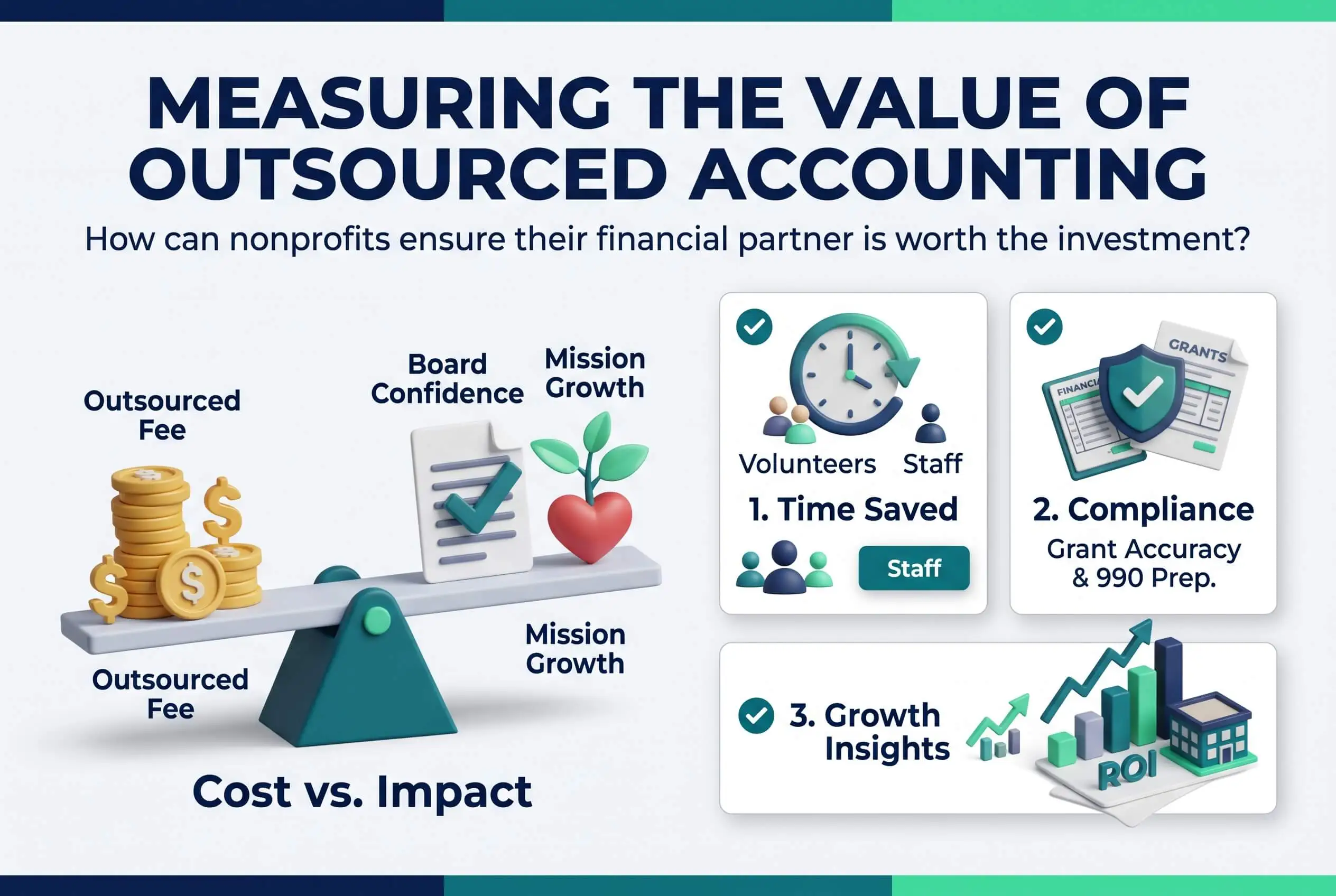
Every month your accounting provider sends an invoice, and every quarter your board sees the total. Eventually a treasurer turns to the expense page and asks what that money buys. You can answer with numbers. Set the fee against what the same work would cost you another way, then track a short list of finance measures from the first month and review them at 90 days and again after your first audit.
We wrote this for executive directors and finance committee members weighing outsourced accounting for nonprofits, and for the coaches and consultants who often sit in on those decisions. Most of what's been published on the topic lists benefits, which are easy to agree with and hard to measure. Your board needs something it can check.
TL;DR Quick Answers
Outsourced Accounting for Nonprofits
Outsourced accounting for nonprofits means an outside team runs your finance function, from fund-level bookkeeping and the monthly close to grant reporting and audit support, so your staff can stay focused on the mission. It earns its fee when you can measure the difference.
What it covers: Restricted fund tracking, functional expense allocation, budget-to-actuals for funders, board reporting, and audit and Form 990 readiness.
Who it fits: Organizations whose grants, restrictions, and audit requests have outgrown a part-time bookkeeper but don't yet justify an in-house finance department.
Levels of support: Bookkeeping for clean, audit-ready books, outsourced accounting for the close and reporting, and a fractional CFO for forecasting and board strategy.
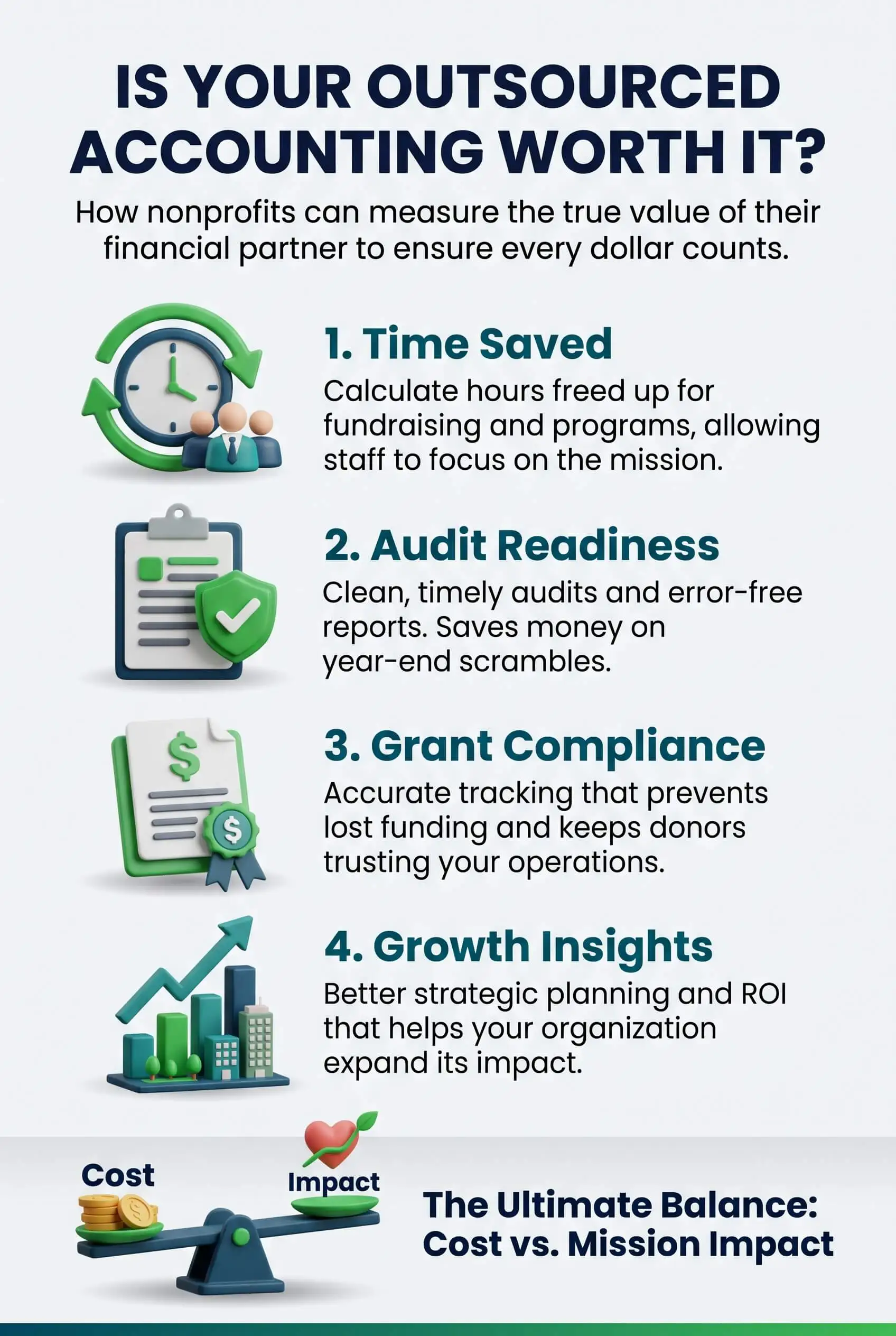
How to judge value: Compare the fee with a fully loaded hire or the quiet cost of the status quo, then track days to close, audit adjustments, on-time grant reports, and cash visibility from month one.
When to review: At 90 days, after the first audit, and at budget time each year.
What stays with you: The board keeps fiduciary oversight. Good outsourcing makes that oversight easier.
Quick test: Ask your provider for last quarter's close dates. A fast, specific answer is a good sign.
Top Takeaways
Compare the fee with your real alternative, either a fully loaded hire or the quiet cost of the status quo.
Set a baseline in month one, or you won't be able to prove anything later.
Track the close date, board report timing, audit adjustments, grant deadlines, restricted fund reconciliation, leadership hours, and cash visibility.
Review at 90 days, after the first audit, and at budget time each year.
Name the value the ROI formula can't price, and your board will trust the numbers it can.
What Outsourced Accounting for Nonprofits Actually Covers
An outside team takes over some or all of your finance function, from recording and reconciling transactions to closing the books and preparing reports. Accounting outsourcing is common in every industry. Nonprofit books, though, carry obligations a general bookkeeper often isn't built for, and a 501(c)(3) has little room for error.
Restricted funds: Donor and grant restrictions need tracking at the transaction level, so restricted balances stay accurate and nobody spends the same grant dollar twice.
Functional expenses: Every cost gets split between program, management and general, and fundraising, using a method you can defend to an auditor. That split also feeds your Form 990.
Grant reporting: Funders want budget-to-actuals on their calendar and in their template, and neither one usually matches yours.
Donation platform syncing: Gifts recorded in tools like Bloomerang or DonorPerfect have to land in the ledger cleanly. When they don't, the books and the donor database slowly drift apart.
Audit and 990 support: Someone has to prepare schedules, answer auditor questions, and keep documentation where your team can find it in March.
Before you measure anything, confirm which level of support you're paying for. Bookkeeping keeps records clean and audit-ready. Outsourced accounting adds the monthly close, allocations, and board reporting. A fractional CFO layers forecasting and strategy on top. We often see organizations grade a bookkeeping engagement against CFO-level expectations, and no bookkeeper passes that test.
Start With What the Work Would Cost Another Way
Measured against zero, any invoice looks expensive. The fairer test is your real alternative. For most nonprofits that means hiring a staff accountant or leaving the work where it sits now, usually split between the executive director and a part-time bookkeeper who's already stretched thin.
If you'd hire, count the fully loaded cost:
Salary, with the U.S. median for accountants and auditors at $83,680 as of May 2025
Benefits and payroll taxes
Accounting software, training, and continuing education
Recruiting, plus the months the seat sits empty after someone leaves
If you'd stay put, the costs are quieter but still add up. Count your executive director's weekly hours on finance, your auditor's bill for year-end cleanup, and any grant report that went in late.
For a very small organization with simple books, outsourcing can cost about what a good part-time bookkeeper does. Sometimes more. That's fine. It just means the value has to show up somewhere other than payroll.
The Nonprofit Accounting Scorecard: 7 Numbers to Track
The simplest way to judge outsourced accounting for nonprofits is to write down a few numbers in the first month and watch where they go. Check them every quarter.
Days to close: How long after month-end your financials are final. You want this steady from month to month and shorter than before.
Board report timing: When financials reach the board or finance committee. They should arrive before every meeting without anyone chasing them.
Audit adjustments: Proposed adjustments plus management letter comments. Fewer each year is the goal.
Grant reports on time: The share of funder reports filed by deadline. Anything short of all of them deserves a conversation.
Restricted fund reconciliation: Whether restricted balances tie to the general ledger every month. A year-end surprise here is a red flag.
Leadership hours on finance: Weekly time the ED and program staff spend on accounting tasks. It should trend down.
Cash visibility: Whether you can say, on any given day, how many months of operating cash you have and when the next grant payment lands.
The scorecard tells you whether the service is working and gives your board something concrete to discuss. If a provider can't help you track these numbers, that tells you something about the provider.
A Simple Way to Calculate ROI
The formula fits on a sticky note:
ROI = (costs avoided + measurable value gained − annual service cost) ÷ annual service cost
Picture a hypothetical nonprofit with a $2.5 million budget that pays $600 a week, or $31,200 a year, for outsourced accounting. These figures are illustrative, not anyone's quote.
Compared with hiring: A staff accountant at the $83,680 median, plus roughly 30% for benefits and payroll taxes and about $6,000 for software and recruiting, runs around $114,800 a year. Against the $31,200 fee, the organization avoids about $83,600, an ROI near 268%.
Compared with the status quo: Say the executive director gets back six hours a week, worth about $15,840 a year at $55 an hour. Add $3,500 in shorter audit fieldwork and $5,000 in year-end cleanup the organization stops paying for. That's $24,340, which falls short of the fee. On hard dollars alone, the ROI lands around negative 22%.
That second number surprises people. We think it's the more honest one. When outsourcing replaces a hire you'd otherwise make, the math argues for you. When it replaces work that stretched staff do for "free," part of the case lives outside the formula. Your board trusts the reports, funders get their numbers on time, and the books hold together when someone leaves.
CALM, one of the nonprofits Accountix works with, shows what that looks like. After adding fractional CFO support and better systems, CALM reduced its receivables days and moved to clearer, audit-ready reporting, according to the CALM case study. Neither result fits neatly into a one-year ROI. Name benefits like those plainly instead of folding them into a savings claim. It's the same logic behind judging coaching by its return rather than its price.
When to Review the Engagement
Put three dates on the calendar and bring the scorecard to each one.
At 90 days: Cleanup should be finished, a close schedule set, and the first monthly reports arriving on time. Ask which accounts needed the most correction and why, and whether your chart of accounts now supports fund and functional tracking.
After the first audit: Compare adjustments, fieldwork time, and the management letter with the year before. Ask which auditor requests the provider handled directly and what would make next year smoother.
At budget time each year: Check whether the scope still fits your size and complexity. You may be paying for support you don't use, or missing something you now need, like cash flow modeling tied to grant timing.
Providers who trust their own work tend to welcome these meetings.
Signs It Isn't Worth It (Yet)
Reports arrive on schedule, but nobody on your team can explain what they mean.
The close date keeps drifting later instead of settling.
Restricted balances still surprise you at year-end.
You're paying for strategic CFO hours when your real gap is clean, timely books.
Your books are simple enough that a capable bookkeeper would cover them.
Whatever you decide, oversight stays with the board. Outsourcing hands off the work but leaves the fiduciary role with you, so choose a partner whose reports make that oversight easier rather than one you have to take on faith.
Matching the Service Level to What You Measure
Your scorecard often points straight to the right level of support.
Late books and fund balances you don't trust point to nonprofit bookkeeping.
Missed grant reports, shaky budget-to-actuals, and painful audits point to outsourced accounting.
A board asking for forecasts, scenario planning, and cash flow tied to grant timing points to a fractional CFO.
Most nonprofits start at one level and add support as their programs grow. That's how it should work, as long as each step up fixes a problem the scorecard shows.
"Boards look at the invoice first, and it's usually the least helpful number on the page. In our work with nonprofits, the earliest sign an engagement is working is the close date. It stops drifting. The second shows up in the first audit, when the auditor asks for a schedule and it's already sitting there. If neither has happened after two quarters, have a direct conversation with your provider."
7 Essential Resources
These are worth bookmarking before your next finance committee meeting.
IRS: Instructions for Form 990: Part IX covers the statement of functional expenses and spells out how program, management, and fundraising costs must be reported.
National Council of Nonprofits: What Is an Independent Audit?: Explains what auditors examine and why funders and boards request audits. Read it before you judge your own audit readiness.
Journal of Accountancy: Simplifying Adoption of the NFP Financial Reporting Standard: Two CPAs walk through ASU 2016-14, from net asset classes to liquidity disclosures and functional allocation.
eCFR: 2 CFR Part 200 (Uniform Guidance): The federal cost principles and audit requirements. If you receive federal grant money, your accountant should know this cold.
Nonprofit Finance Fund: Full Cost Framework: Shows the true cost of running programs, reserves and working capital included, so your board can judge finance spending in context.
Nonprofit Finance Fund: 2025 State of the Nonprofit Sector Survey: Sector benchmarks on deficits, cash reserves, and staffing to hold your own numbers against.
Accountix: Nonprofit Accounting Glossary for Leaders and Boards: Plain-English definitions of 79 terms, handy when a new board member asks what "net assets with donor restrictions" means.
3 Statistics
36% of nonprofits surveyed ended 2024 with an operating deficit, the highest share in 10 years of survey data, according to Nonprofit Finance Fund's 2025 State of the Nonprofit Sector Survey. With margins that thin, every overhead dollar, accounting included, needs a clear return.
52% of respondents to the same NFF survey have three months or less of cash on hand, and 18% have a month or less. When half the sector runs that close, knowing exactly when grant payments will land becomes survival planning. NFF's figures come from 2,206 nonprofits that chose to respond, so read them as a strong signal rather than a census.
$83,680 was the median annual wage for accountants and auditors in May 2025, and the top 10% earned more than $144,090, according to the U.S. Bureau of Labor Statistics. Benefits and payroll taxes come on top of that, which is why fully loaded costs belong in any comparison.
Thin margins and short cash runways, combined with rising salaries, mean finance support deserves the same scrutiny you'd give any program expense. If you're comparing providers, this guide on how to tell whether an outsourced accounting firm is reliable covers the questions to ask before you sign.
Final Thoughts and Opinion
We'd argue the invoice is the least useful number in this decision. It shows what you spend and says nothing about what comes back. The close date and the audit tell you far more, and so does how quickly someone can answer when a board member asks how a restricted grant is tracking.
In our view, most nonprofits wait too long to start measuring. They sign on, feel some relief, and never set a baseline, so a year later nobody can say whether anything improved. Write down the seven numbers in month one. If they move, your board gets the evidence it's been asking for. If they haven't moved after two quarters, say so. A good partner would rather hear it early than lose your trust slowly.
Still sorting out what kind of support fits? Start with the difference between virtual and outsourced accounting before you compare prices.
Frequently Asked Questions
How much does outsourced accounting cost for a nonprofit?
Cost depends mostly on transaction volume and how much grant and board reporting you need. As a reference point, Accountix lists bookkeeping from $200 per week for organizations under $2 million in revenue, outsourced accounting from $350 per week for $1 to $3 million, and a full accounting department from $1,000 per week above $3 million. Accountix tailors the final scope to each organization.
Is outsourced accounting cheaper than hiring an in-house accountant?
Usually, the alternative is a full-time staff accountant. Add benefits, payroll taxes, software, and recruiting to the $83,680 median salary and a hire often runs well past $100,000 a year. If your alternative is keeping things as they are, outsourcing may cost more in hard dollars, and the return shows up as accuracy and continuity.
How long before we can tell whether it's working?
Early signs appear around 90 days, once cleanup is done, a close schedule is set, and reports arrive on time. The fuller picture comes after your first audit, when you can compare adjustments, fieldwork time, and the management letter with the prior year. Most organizations have a clear answer within two or three quarters.
Can outsourced accounting lower our audit fees?
It can. When your provider reconciles the books monthly and has schedules ready before fieldwork, auditors spend less time on cleanup and fewer questions pile up at year-end. Savings depend on the audit firm and on how messy the prior year was, so track fieldwork hours and adjustments rather than counting on a specific discount.
What should our board review to judge the service?
Ask for a short quarterly scorecard covering days to close, report timing, audit adjustments, on-time grant reports, restricted fund reconciliation, and months of cash on hand. Compare each figure with the first-month baseline. Trends tell you more than any single number.
Does the board still carry financial responsibility if we outsource?
Yes. Outsourcing moves the work, and the fiduciary duty stays with the board. You still approve budgets, review financial statements, and oversee the audit. Good outsourced accounting for nonprofits makes that oversight easier by delivering reports on time and explaining them in plain language.
Will an outsourced team handle our Form 990?
Most nonprofit-focused providers prepare the financial data and schedules the 990 draws on, then coordinate with whoever prepares and signs the return, often your audit or tax firm. Get that split in writing before the engagement starts so nothing falls between the two.
Get Financial Clarity for Your Mission
If your board keeps asking what the accounting line buys, Accountix can help you answer with numbers. Book an intro call to walk through your current setup and the scorecard, and find out whether bookkeeping, outsourced accounting, or a fractional CFO fits where your organization is today. You don't need to build a finance department to get there. A 30-minute conversation. No sales pitch, just clarity.


