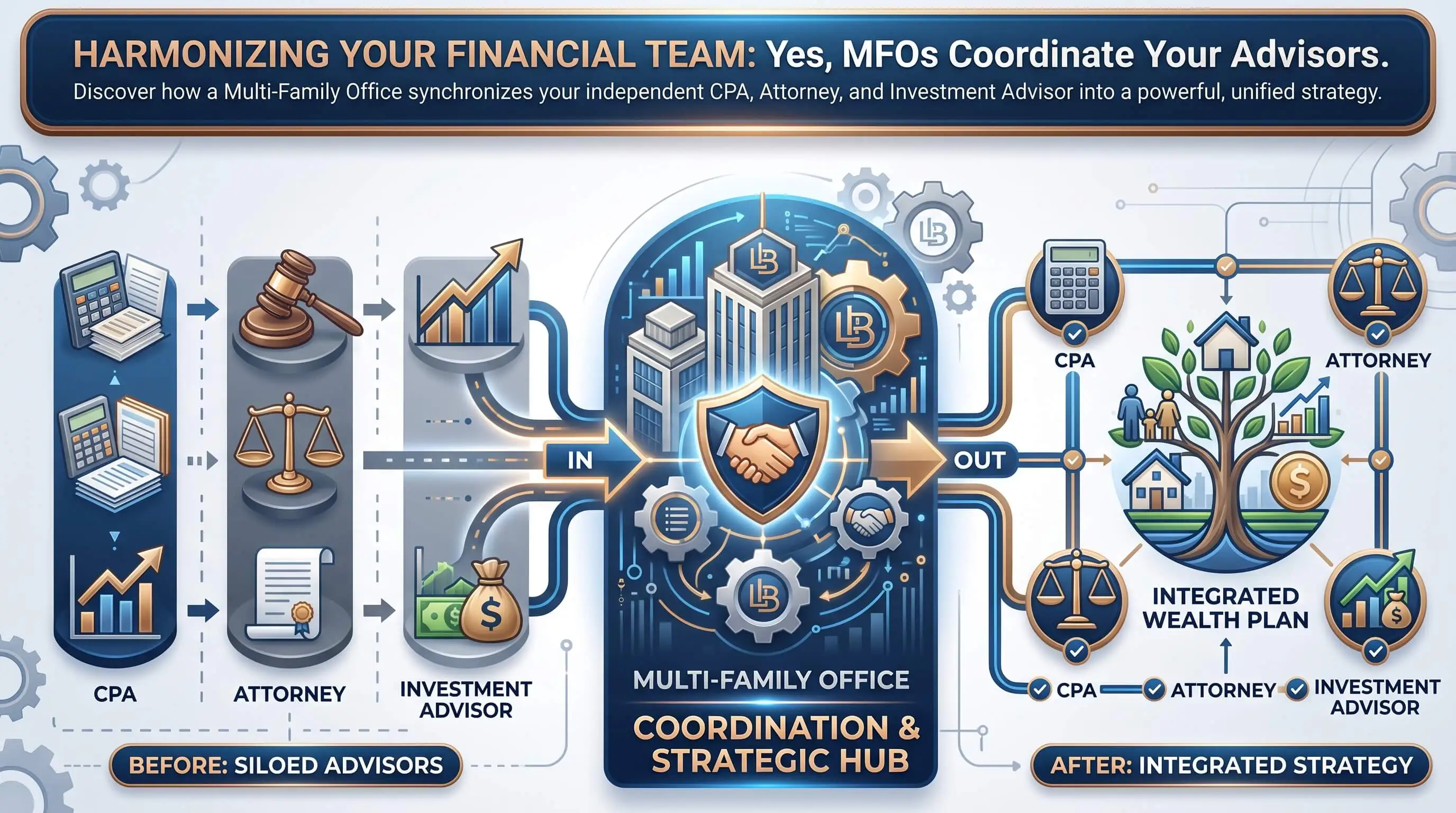
Yes. A multi-family office can coordinate all three and keep them working from the same balance sheet and the same plan, without replacing any of them.
Think about how it works for most families today. Your CPA has a question about a trust your attorney drafted two years ago, so you forward the email. The attorney's answer changes how your investment advisor should hold those assets, so you forward that one too. Three capable professionals, and the only person who has read the whole thread is you.
In our work with families, that relay is where the expensive mistakes happen. It is also the gap that multi family office wealth management services are built to close. One team holds the full balance sheet and owns the follow-through, so you no longer have to.
If you have ever worked with a coach, the idea will feel familiar. Most people who hire one already know what to do, and what they pay for is the accountability a business coach provides: someone who keeps every part of the plan moving together.
TL;DR Quick Answers
Multi Family Office Wealth Management Services
A multi-family office is an independent advisory firm that gives several families access to the kind of coordinated support a private family office provides, without the cost of building one. Its central job is to keep your investments, tax planning, estate planning, and trusts pointed at one strategy. In practice, that coordination covers:
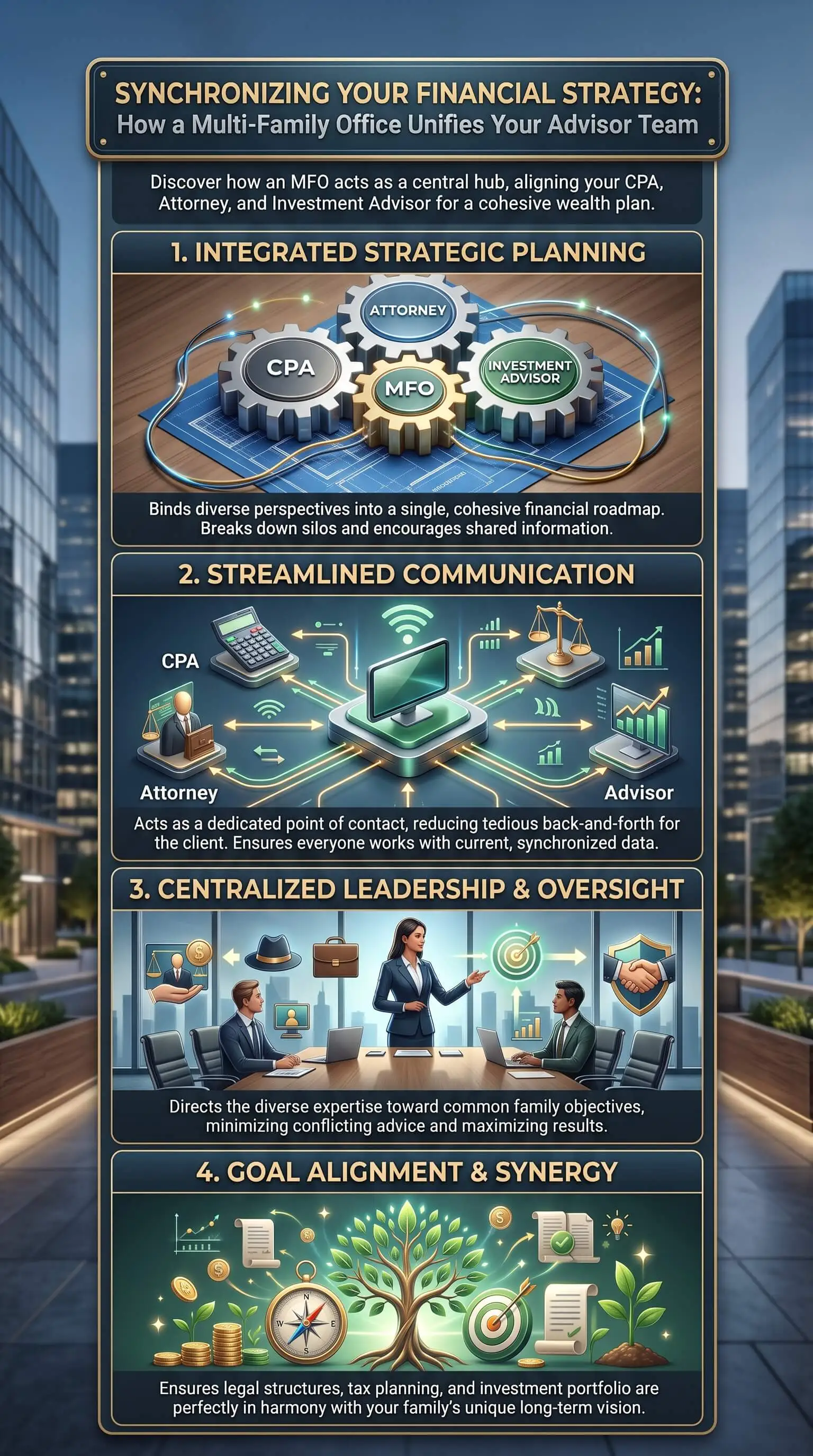
One balance sheet: every advisor works from the same, current numbers.
Shared follow-through: open items have owners and dates.
Joint decisions: your CPA, attorney, and investment advisor meet before big moves, not after.
Year-round tax visibility: your advisors plan gains, gifts, and estimated payments before you file, rather than reacting to them afterward.
Family communication: heirs and trustees know who to call.
Quick test: ask who makes sure your CPA and your attorney have seen the same numbers. If the honest answer is you, coordination deserves a closer look.
Top Takeaways
A multi-family office can coordinate your CPA, estate attorney, and investment advisor so all three work from one balance sheet and one plan.
Coordination does not mean replacement, and most families keep the advisors they trust.
The biggest risks sit in decisions that cross disciplines, such as a business sale or a trust that still needs funding.
In practice, coordination means one set of numbers, an open-items list with named owners, joint meetings before major decisions, and tax planning that runs all year.
If you have become the messenger between your advisors, your planning has likely outgrown its current structure.
Why Good Advisors Still Work in Silos
When advice goes sideways, the cause is usually the structure around your advisors rather than the advisors themselves.
Each professional is licensed for one lane and paid to stay in it. Your CPA answers for the return and your attorney for the documents, while your investment advisor answers for the portfolio. No one is paid to own the space between those lanes, which is exactly where multi family office wealth management services add value by coordinating the work across every advisor.
For routine work, that rarely matters. It starts to matter the moment one decision touches tax, legal, and investment questions at once.
Where Your CPA, Attorney, and Investment Advisor Overlap
The decisions that shape a family's wealth almost never belong to a single advisor. Here is how the work typically divides across five of the most common ones.
Selling a business
CPA: Models the tax outcome of deal structures
Estate attorney: Reviews gifting and trust planning before close
Investment advisor: Plans for liquidity and diversifying proceeds
What the multi-family office coordinates: Timing, sequencing, and one shared set of numbers
Funding a trust
CPA: Reports trust income and gift tax filings
Estate attorney: Drafts the trust and advises on funding
Investment advisor: Retitles and invests trust assets
What the multi-family office coordinates: Making sure the trust actually gets funded as intended
A large charitable gift
CPA: Estimates the deduction and its limits
Estate attorney: Structures the vehicle, such as a foundation or charitable trust
Investment advisor: Chooses which assets to give
What the multi-family office coordinates: Picking the gift that fits tax, estate, and portfolio goals together
A Roth conversion or large realized gain
CPA: Projects the tax bill and bracket impact
Estate attorney: Checks effects on estate and beneficiary plans
Investment advisor: Plans cash for taxes and rebalancing
What the multi-family office coordinates: Year-round tax visibility instead of filing-season surprises
Updating beneficiary designations
CPA: Flags income tax effects for heirs
Estate attorney: Confirms designations match the estate plan
Investment advisor: Updates account paperwork
What the multi-family office coordinates: Keeping every account consistent with the plan
Timing and sequencing matter in every one of these as much as the advice itself. We have seen sound advice cost a family money simply because it arrived in the wrong order. Outsourced family office executive services help manage that sequencing by coordinating advisors, tracking decisions, assigning responsibility, and keeping important financial and family matters moving in the right order.
How Does a Multi-Family Office Coordinate the Three?
Coordination can sound vague until you see it week to week. In practice, it comes down to a handful of habits we keep with every family.
One consolidated balance sheet. Every advisor works from the same view of assets, liabilities, trusts, and entities, so no one is planning around outdated numbers.
A shared list of open items. Each item has an owner and a date, so when something stalls, someone notices within days instead of at year-end.
Joint meetings before major decisions. Your CPA, attorney, and investment advisor hear the same facts at the same time, and they can raise concerns before anything is signed.
Briefings that go both ways. The multi-family office keeps each advisor informed, so you are no longer the messenger.
Tax visibility all year. The team plans estimated payments, gains, and gifts throughout the year, so filing season holds no surprises.
A Worked Example: The Business Sale
The scenario below is a hypothetical illustration rather than a client story, though the pattern is one we see often.
A business owner receives a letter of intent from a buyer. Before the owner signs anything, the multi-family office gets all three advisors on the same call. The CPA models how each deal structure would be taxed. The attorney looks at whether some shares should move into trusts for the children before the sale, while their value is still lower. Meanwhile, the investment advisor works out where the proceeds will sit and how to reduce concentration over the next few years.
When those conversations happen one at a time, and sometimes after closing, the best options are often already gone. Coordinated, the family makes a single decision with every view on the table.
What Happens When Your CPA and Attorney Disagree?
The multi-family office does not overrule either one. It lays the tradeoff out on a single page in plain language, showing what each recommendation accomplishes and what it costs or risks. The family then decides with both views in hand, instead of going with whichever advisor called last.
Can I Keep My Current Advisors?
Yes, and most families do. A multi-family office fills the coordination gap. It is not there to push out advisors you already trust.
Why Not Let Your Investment Advisor Quarterback?
Many investment advisors coordinate well within their mandate, and for some families that is enough. The difference is scope. A multi-family office starts from the full balance sheet rather than the investment account, which matters more as trusts and entities multiply across generations. Legacy Bridge works with families managing $10 million or more, with fit based on complexity rather than a single number, and can coordinate with outsourced business and financial accounting firms as part of the broader advisory structure. Fees are usually asset-based, a flat retainer, or a hybrid of the two.
"Families rarely come to us because an advisor gives bad advice. They come because good advisors gave advice in isolation and nobody checked how it fit together. The costly moments we see are almost always handoffs, like a trust that was drafted but never funded, or a sale structured before anyone reviewed the estate plan. Our job is to own those handoffs so the family does not have to."
7 Essential Resources
Whether or not you bring in a multi-family office, these resources will help you vet each member of your team and understand the decisions they share.
SEC Investment Adviser Public Disclosure: Look up any investment adviser's registration and read their Form ADV. It shows how the firm is paid, what conflicts it discloses, and whether it has a disciplinary history.
Investor.gov: Investment Professionals: The SEC's plain-language guide to choosing an investment professional, including questions to ask and how to read a Form CRS relationship summary.
IRS: Choosing a Tax Professional: Explains the different kinds of tax preparers and links to the IRS directory of preparers with recognized credentials. A good starting point before a complex year.
CPAverify: The National Association of State Boards of Accountancy's free national lookup for licensed CPAs and CPA firms. Use it to confirm your CPA's license status in minutes.
The American College of Trust and Estate Counsel: ACTEC Fellows are peer-elected trust and estate lawyers with at least ten years in the field. The site has a lawyer search and free estate planning education.
Morgan Lewis: Control, Cost, and Complexity: Finding the Right Family Office Model: A law firm's comparison of single-family, multi-family, and outsourced family office models. Useful for understanding where coordination fits.
IRS: Donor-Advised Funds: A clear overview of one of the most common giving vehicles. It is also a good example of a decision that needs your CPA, attorney, and investment advisor in the same conversation.
3 Statistics
$124 trillion: the amount of wealth Cerulli Associates projects will transfer to heirs and charity through 2048. Cerulli expects more than half of it, about $62 trillion, to come from high-net-worth and ultra-high-net-worth households, which make up only 2% of all households. Transfers of that size run through tax, legal, and investment decisions at the same time.
24%: the share of Americans who reported having a will in Caring.com's 2025 Wills and Estate Planning Survey, down from 33% in 2022. Among those without one, 43% said they simply had not gotten around to it, which points to follow-through, not knowledge, as the real gap.
$50 million: the net worth that clients of multi-family offices typically exceed, according to Wikipedia's multi-family office entry. Minimums vary widely by firm, though. Legacy Bridge, for example, works with families managing $10 million or more, based on complexity.
Record wealth is changing hands while many estate plans sit unfinished, and complexity now shows up well below the largest fortunes. More families are finding that good advisors working separately are not enough. Someone has to connect the work.
Final Thoughts and Opinion
In our experience, the advice itself is rarely what goes wrong. Most families we meet already work with capable professionals. The trouble shows up in timing and handoffs, like the trust that never got funded or the gift that made sense for taxes but pulled the portfolio off course.
So the question is not whether you need fewer advisors or better ones. The better question is whether anyone is responsible for how their work fits together. A CPA, an attorney, and an investment advisor can each do excellent work and still leave a family exposed if no one owns the space between them.
The families who handle this well usually act before a crisis. They notice they have become the go-between, or they see a big decision coming, and they put structure in place first. Business owners will recognize the instinct from outsourced accounting support for growing businesses. Once the moving parts outgrow one person's attention, you bring in a team built to manage them.
Frequently Asked Questions
Does a multi-family office replace my CPA or estate attorney?
No. A multi-family office coordinates your CPA and estate attorney rather than replacing them. Your CPA still prepares returns and gives tax advice, and your attorney still drafts and reviews documents. The multi-family office keeps both working from the same information and tracks what has to happen next.
Can a multi-family office work with advisors I already have?
Yes. Most families keep their existing CPA, attorney, and investment advisor. A well-run multi-family office works alongside outside professionals, shares information with them, and brings them together whenever a decision affects more than one part of the family's wealth.
Who leads the meetings between my advisors?
Usually the multi-family office sets the agenda, gathers the numbers in advance, and runs the meeting. Each advisor arrives with the same facts, and the family leaves with clear decisions and named owners rather than a separate set of notes from every office.
Does a multi-family office give legal or tax advice?
A multi-family office coordinates tax and legal work, but licensed professionals give that advice. Some firms employ CPAs or attorneys on staff, while many work with outside counsel and accountants. Ask any firm you are considering which services it provides directly and which it coordinates.
How much does multi-family office coordination cost?
Costs vary by firm, scope, and complexity. Most firms charge a percentage of assets under management, a flat annual retainer, or a hybrid of the two. Any firm you hire should disclose its fees in writing and show you exactly which services they cover.
How do I know if my family needs this level of coordination?
Watch for a pending business sale or inheritance, trusts or entities spread across several advisors, recommendations that conflict, or the sense that you are the only one who sees the full picture. Legacy Bridge works with families managing $10 million or more, with fit based on complexity.
Get Your Advisors Working From One Plan
When your advisors need each other to do their jobs well, it may be time to put someone in the middle. These steps will help you prepare for that conversation:
List each advisor and what they own today.
Note the last decision that needed more than one of them, and how it went.
Pull together recent tax returns, trust agreements, estate documents, and investment statements.
Confirm that any firm you speak with is a fiduciary and check its Form ADV.
Legacy Bridge Private Family Offices is an independent, SEC-registered fiduciary based in West Des Moines, Iowa, serving families nationally. We help families align the advisors they already trust around one coordinated strategy. If you would like to talk through how that could work for your family, a private conversation is a good place to start.
One call. One team. One coordinated strategy, supported by family office trust and business transition services that help keep complex wealth, ownership, and succession decisions aligned.