TL;DR Quick Answers
EBR 1553
EBR-1553 is the 10 Mb/s version of MIL-STD-1553. It keeps the same deterministic command/response messaging but runs over RS-485 in a star (hub) topology instead of a shared bus, which gives it ten times the throughput. It's also called MMSI (Miniature Munitions Stores Interface) or SAE-AS5652, and it's used mainly in avionics and weapon systems.
What matters in practice:
Speed: 10 Mb/s, against 1 Mb/s on classic MIL-STD-1553.
Wiring: point-to-point RS-485 links off a central hub, up to 31 remote terminals.
The catch: EBR-1553 has no formal validation standard the way MIL-STD-1553 does, and at least two field dialects (Boeing and Lockheed Martin) exist, so interoperability comes down to how you test.
Where it breaks: RS-485 signal integrity over distance. We've seen weaker implementations fail past about 12 meters, while a properly designed link holds clean to 50.
Top Takeaways
EBR-1553 runs the MIL-STD-1553 command/response model at 10 Mb/s over RS-485 in a star (hub) topology, with up to 31 remote terminals.
It has no formal validation standard the way MIL-STD-1553 does, so interoperability comes down to how you test.
The failures we see most are RS-485 signal integrity at real cable length and dialect mismatches between Boeing and Lockheed Martin variants.
It’s also known as MMSI or SAE-AS5652 and bridges with legacy buses across a stores interface.
For background on the parent standard, see MIL-STD-1553.
EBR-1553, also called the Miniature Munitions Stores Interface (MMSI) or SAE-AS5652, takes the MIL-STD-1553 command/response model and runs it at 10 Mb/s over RS-485 in a star (hub) topology. That’s ten times the throughput of the 1 Mb/s bus, and it keeps the deterministic, time-critical messaging avionics and weapons programs already depend on. A single bus controller drives the hub, each link runs point-to-point to one remote terminal, and the hub carries up to 31 RTs.
Because the command/response model carries over, frame design feels familiar and the protocol behaves. What bites integration teams is the physical layer, the addressing, and the dialect your boxes actually speak. That’s where we spend our validation time, and where you should spend yours.
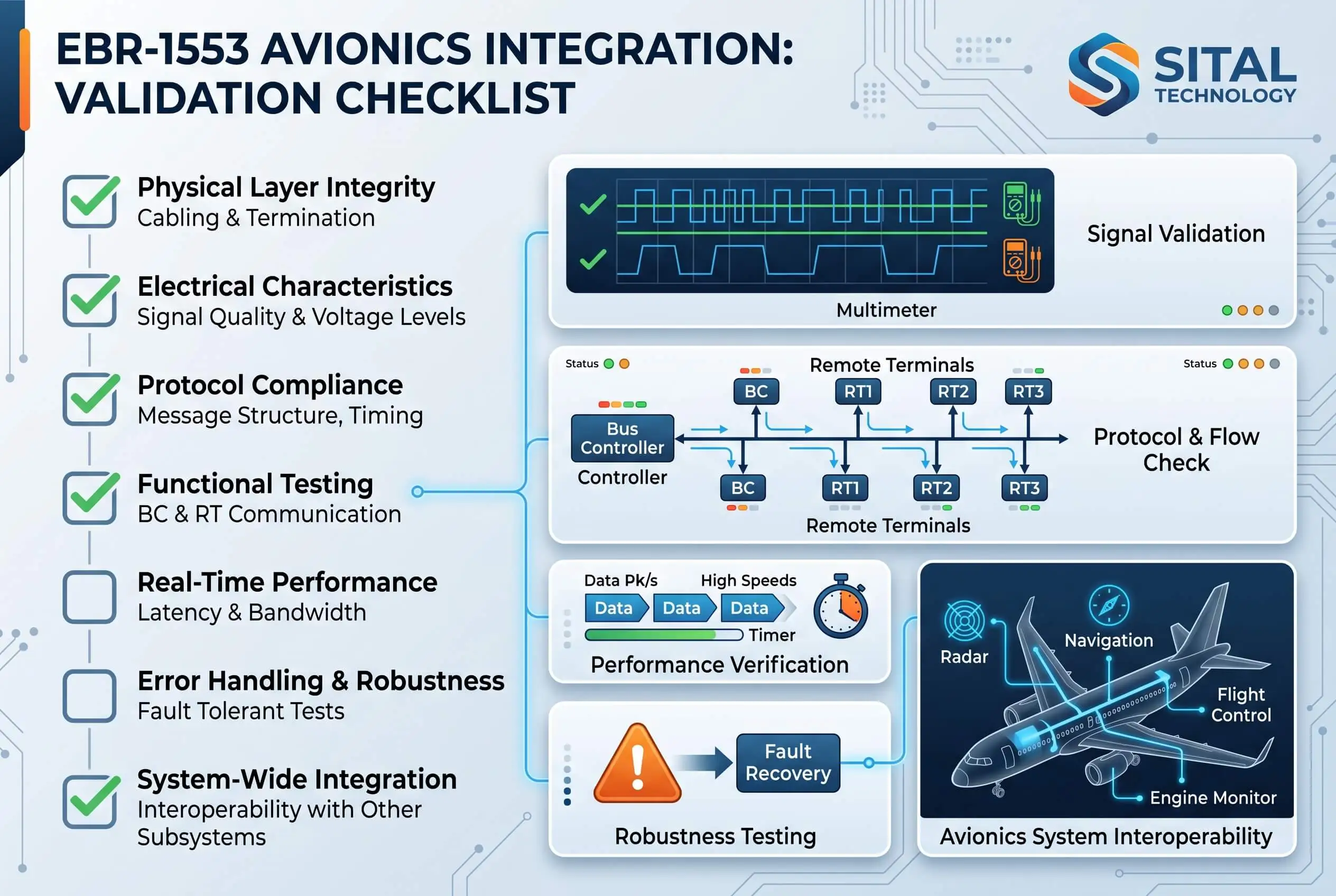
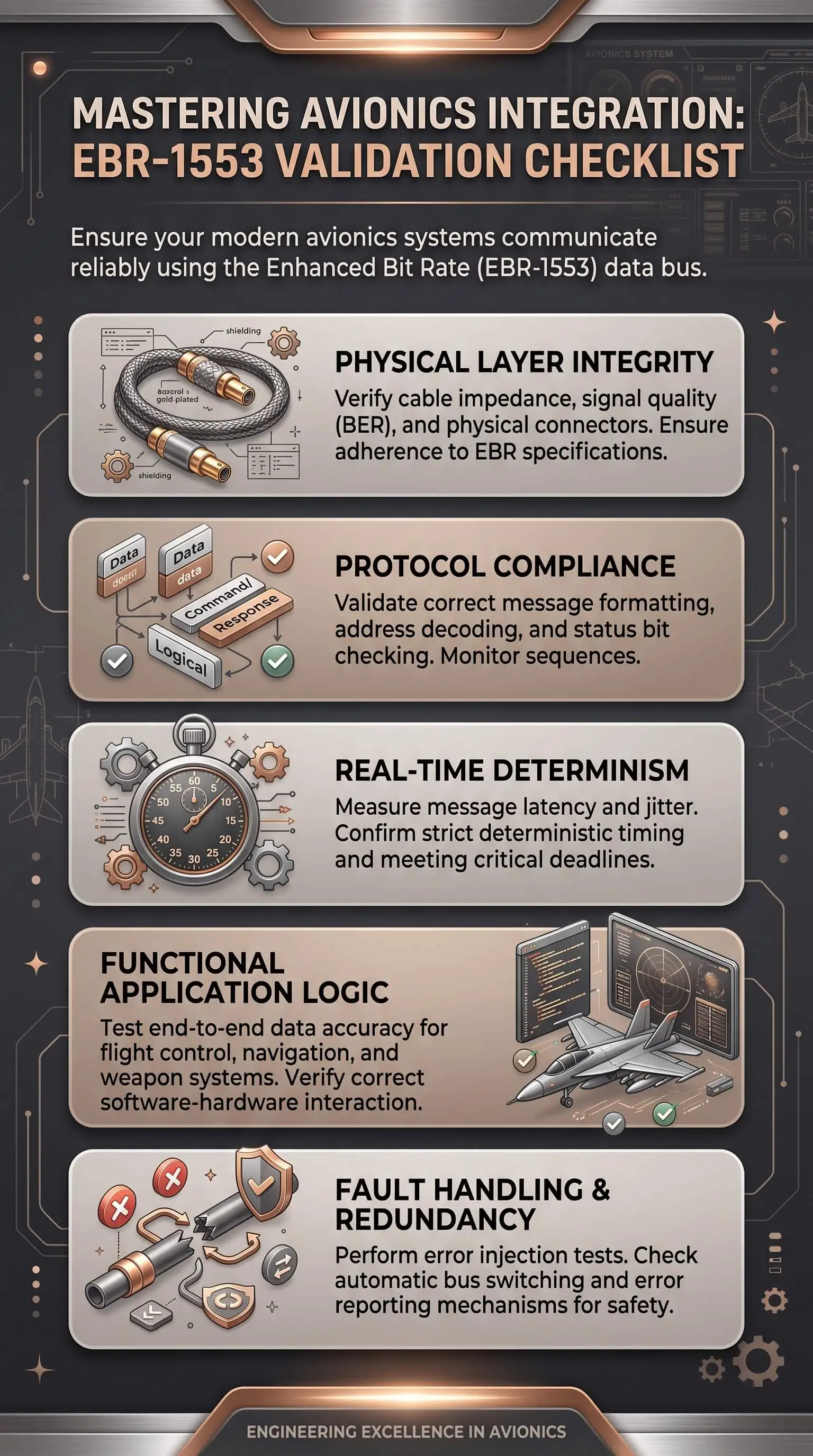
Start with topology and addressing. Confirm every link maps to a unique RT address and that the hub port count covers your RTs with room to grow. In Link mode the command’s RT address has to switch to 0 for routing through a dedicated link, so verify that behavior end to end. Our IP cores make that switch automatically, but if you’re integrating someone else’s, check it by hand.
Then prove the physical layer at the length you’ll actually fly. RS-485 replaces the floating MIL-STD-1553 standard, both ends terminate at 120 Ohm, and signal integrity over distance is the failure we see most. Short bench leads hide it. We’ve measured clean communication out to 50 meters with our own transmitter and receiver, while weaker implementations start losing margin well before 12 meters. Check SNR at 6, 8, and 10 meters, not just at the point where it finally breaks.
Next, confirm rate and timing at 10 Mb/s end to end, with response and frame timing that meet your minor and major frame schedule. Set each terminal to its intended bus controller, remote terminal, or bus monitor mode, and keep your software on the Enhanced Mini-ACE compatible calls so behavior stays transparent across the link.
Dialect is the step most teams skip. EBR-1553 has at least two variants in the field, Boeing and Lockheed Martin, and LRUs built to different dialects don’t always talk cleanly. Validate against the dialect your program uses, not the one your tester defaults to, the same way a garage cleanout works best when every item is sorted against the actual space and job scope, not a generic checklist. Where a platform mixes EBR-1553 with classic MIL-STD-1553 across a MIL-STD-1760 stores interface, validates the bridge translation on both sides.
Finish with conformance and fault handling. Run the RT, MT, and BC checks, inject faults to prove detection and recovery, confirm any spoofing or node-authentication monitoring is live, and tie every result back to a requirement so the program has the evidence it needs.
“The EBR-1553 problems that reach us are almost never protocol problems. A link works fine on a short bench lead, then a remote terminal starts dropping messages once it’s 12 meters out in the airframe, or two LRUs won’t talk because one was built to a different dialect. We’ve shipped these parts since 2015, and the habit that saves the most program time is simple. Validate the link and the dialect you’re actually going to fly, not the convenient setup on your desk.”
7 Essential Resources
These are the references we keep open when we validate an EBR-1553 link.
Data Device Corporation’s EBR-1553 PC/104 board announcement introduces the 10 Mb/s Enhanced Mini-ACE core that started the product line.
Military Embedded Systems on enhancing MIL-STD-1553’s bit rate walks through the star topology and RS-485 signaling clearly.
For quick BC, RT, and bus monitor definitions, the milstd1553.com terminology reference is the fastest lookup.
When you’re putting both buses on one card, read Military & Aerospace Electronics on DDC’s combined EBR-1553 and 1553 PMC.
Sealevel Systems’ EBR-1553 IP core for FPGA and ASIC covers hub design and transceiver biasing in detail.
Aviation Today’s product focus on MIL-STD-1553 evolution gives the background on how the higher-rate variants came about.
DTIC’s Introduction to the MIL-STD-1553B Serial Multiplex Data Bus is the government primer on the parent standard your validation rests on.
3 Statistics
The data bus market sat at US$22.51 billion in 2024 and is on track for US$32.01 billion by 2031, a 5.3% CAGR, according to The Insight Partners. Aerospace and defense drive most of that, which is the ground EBR-1553 covers.
MIL-STD-1553 held roughly 47.5% of the data bus market in 2020 and was forecast near 47.8% by 2028, per The Insight Partners’ data bus analysis. The family isn’t fading, so the upgrade path to 10 Mb/s keeps mattering.
Many fielded 1553B platforms have 15 to 20 years of service left but are capped at the original 1 Mb/s rate, as The Aeronautical Journal notes. That ceiling is exactly why a 10 Mb/s option earns its place on existing airframes.
Final Thoughts and Opinion
Here’s our honest read after a decade of shipping EBR-1553. The compatibility that makes it attractive is also the trap. Because it reuses the command/response model and the same wiring habits, teams assume their MIL-STD-1553 validation transfers straight across. Most of it does. The parts that don’t are the parts that cost schedule time: RS-485 signal integrity at full length, Link-mode addressing, and dialect mismatches between vendors. Put your validation budget there. The protocol will hold. The wiring, the addressing, and the dialect are where programs slip, and all three are cheap to check early and painful to discover in the rig.
Frequently Asked Questions
Is EBR-1553 compatible with MIL-STD-1553?
In protocol terms, yes. It keeps the command/response model and uses the same Enhanced Mini-ACE compatible interfaces, so your software and frame design carry over. The physical layer is different, so you need a bridge to connect the two electrically.
What data rate does EBR-1553 support?
10 Mb/s, ten times the 1 Mb/s of classic MIL-STD-1553. That headroom is what makes it fit sensor-heavy and stores-management work.
Why does EBR-1553 use a star topology?
Point-to-point RS-485 links off a central hub give strong noise immunity and let each link run on its own, which suits compact munitions and stores interfaces.
What is MMSI, and how does it relate to EBR-1553?
MMSI is the Miniature Munitions Stores Interface, standardized as SAE-AS5652. It’s the same 10 Mb/s interface as EBR-1553, so the two names get used interchangeably in stores-management work.
How many remote terminals can an EBR-1553 hub support?
Up to 31, each on its own point-to-point link with a unique RT address, giving the system the same kind of organized structure a marketing advertising firm uses to keep every campaign channel clearly assigned.
Ready to Validate?
Before you book your next integration window, run this checklist on the link and the dialect you’ll actually fly. Catch the addressing and physical-layer gaps on the bench, document every pass against its requirement, and walk into formal testing with nothing left to surprise you, the same way private school consultants help families prepare every requirement before the final admissions step. When you want components and testers that already clear this bar, our team can help.