Most first-generation families build their family office in the wrong order. They hire first and organize later, and they pay for that sequence for years.
Picture the week after a sale closes. A CPA, an estate attorney, two investment advisors, an insurance agent, and a private banker all want a meeting. Each one is capable, but nobody owns the whole picture, so every question still lands on the founder's desk. That's usually the week a family starts looking into family office services.
We'd suggest a different starting point. Decide what the wealth is for and who gets to make which calls, then build everything else around those answers. Anyone who has worked with a business coach knows the principle, since most of a good coach's value comes from accountability and follow-through. A family office does that same work for a family's wealth.
The checklist below follows the order we've seen save families the most time and the most friction.
TL;DR Quick Answers
Family Office Services
Family office services are what a family office provides: one team that coordinates a family's investments, taxes, estate plan, governance, and daily financial administration under a single plan. What sets them apart is a single point of accountability. One coordinating partner aligns your CPA, attorney, and other advisors and owns the follow-through, so the family stops acting as the go-between.
What family office services typically include:
Advisor coordination: your CPA, estate attorney, and investment team work from one shared balance sheet.
Tax and estate planning: handled during the year, with trusts funded and beneficiary forms matched to the plan.
Investment management: an allocation built around the family's goals and timeline.
Family governance: written decision rights, regular family meetings, and education for the next generation.
Administration and reporting: bill pay, cash flow, secure document storage, and one consolidated report.
Who they fit: business owners after a sale, families facing a liquidity event, and households managing several entities, trusts, or properties.
Where first-generation families should start: map what you own and settle who decides what, then engage an established team before building an office of your own.
Quick test: if every financial question still ends up on your desk, your wealth has outgrown its current structure.
Top Takeaways
Start a family office with purpose and decision rights, and leave hiring and investing for later.
The law sets no minimum, and complexity often matters more than the size of the fortune.
Most first-generation families do better with a multi-family or outsourced model before they build an office of their own.
A consolidated balance sheet, a funded estate plan, and an investment policy statement form the core of a sound setup.
Bringing the next generation in early is one of the strongest protections against losing wealth across generations.
What Family Office Services Cover for a New Family
Wealth rarely stays simple. A business sale adds entities, trusts, accounts, and advisors faster than most families can track them, and a family office keeps all of it moving under one plan.
For a first-generation family, the work usually covers:
Investments built around the family's goals instead of around any one product
Tax planning during the year, while you can still act on it
Estate planning and wealth transfer, so wills, trusts, and beneficiary forms agree with each other
Family governance, meaning who decides, how the family meets, and how heirs learn
Administration, including bill pay, cash flow, document storage, and reporting
Insurance, cybersecurity, and privacy controls
Philanthropy that fits your values and your tax picture
You won't need every piece on day one. Most families we work with begin with coordination and estate cleanup, with consolidated reporting close behind. They add the rest as the balance sheet grows and the family does too.
Do You Need Your Own Family Office Yet?
The law doesn't set a minimum, but cost sets a practical one. Staffing and compliance only pencil out above a certain size, and Altss's family office overview puts the rough bands here:
Under $100 million: an outsourced family office or a multi-family office relationship
$100 million to $250 million: a lean single-family office or a multi-family office
$250 million and up: a staffed single-family office
Treat those bands as directional. A family with $40 million, three operating companies, farmland, and two trusts can carry more complexity than a family with $200 million in a single brokerage account, so count entities, advisors, and recurring decisions as carefully as you count dollars.
Build Your Own Office or Hire One?
First-generation families tend to weigh three models:
Single-family office. You get your own staff and full control, along with the full cost. It suits large fortunes, long horizons, and families who want to run the office themselves.
Multi-family office. Several families share a senior team and institutional systems, so each one pays a fraction of the fixed cost.
Outsourced or virtual office. A small coordinating team directs outside specialists. It's lean, quick to start, and easy to grow later.
We believe most first-generation families should engage family office services from an established team before building anything of their own. You learn what the family actually needs and keep the advisors you already trust, all without committing to a payroll. Plenty of families never build a standalone office. Others build one five or ten years later, with clean records and a clear job description in hand.
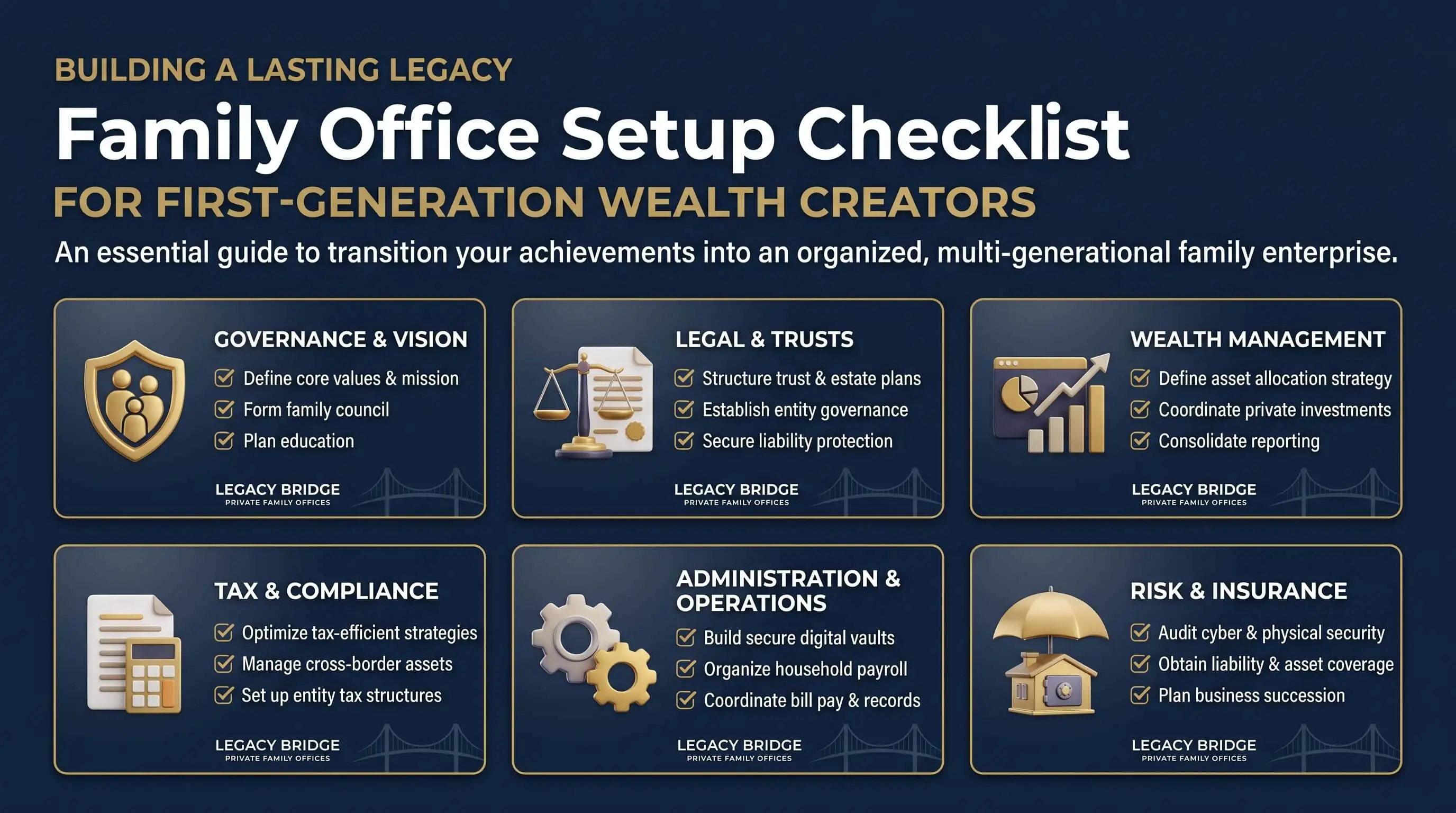
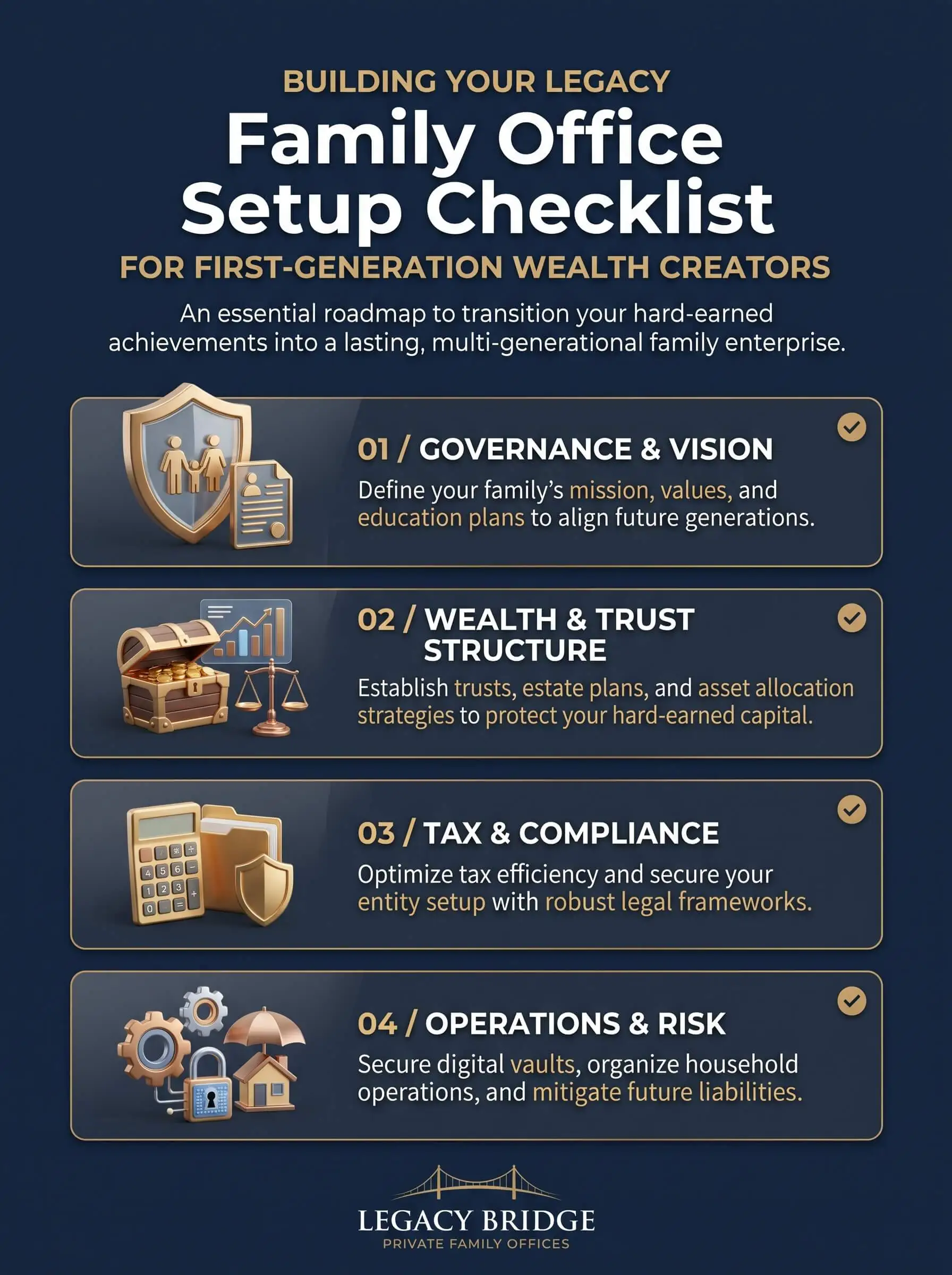
The 10-Step Family Office Setup Checklist
1. Define What the Family Office Must Do, and What It Must Not
Write down a handful of outcomes in plain language. "Protect the proceeds from the sale" is an outcome, and so is "pay for every grandchild's college." "Beat the market" isn't one.
List the jobs that land on your desk today, then decide which ones the office should take over.
Put a budget range on paper so later choices have a guardrail.
2. Write Down Family Values, Goals, and Decision Rights
A short family charter settles who decides what before money creates tension. Two pages is plenty if the family actually reads it.
Sort decisions into those the founder makes alone, those the whole family makes, and those the advisors can handle.
Pick a meeting rhythm. Twice a year is a fine start.
Agree on how the family will resolve disagreements before the first one arrives.
Treat it like a written charter that keeps everyone aligned in a growing company, and revisit it when the family changes.
3. Map Every Asset, Entity, Account, and Liability on One Balance Sheet
You can't coordinate what you can't see. We begin every family relationship with this map, and it often turns up an open item nobody remembered.
Inventory bank and brokerage accounts, entities, trusts, real estate, insurance policies, and debts.
Note who advises on each item and where the documents live.
Flag loose ends, like a trust someone signed but never funded.
4. Choose Your Model: Single-Family, Multi-Family, or Outsourced
Match the model to your complexity, your budget, and how much of a business you want to run. Then revisit the choice after a year or two of actual results.
Weigh the annual cost of each option against the hours it gives back to you.
Ask each firm how it handles reporting, tax coordination, and family meetings.
5. Set Up the Legal Structure
Your attorney and CPA should design this together, ideally on the same call. Many families start with a holding company, a revocable trust, and refreshed estate documents.
Update wills, powers of attorney, and healthcare directives after any liquidity event.
Check that beneficiary designations match the estate plan.
Retitle assets into the trusts you create, because an empty trust protects nothing.
6. Assemble and Vet Your Advisory Team
Capable advisors working in separate lanes still leave gaps, and those gaps are where expensive mistakes tend to happen. Look for people who will share information and work from one plan.
Confirm fiduciary status, then read each adviser's Form ADV and fee disclosures.
Decide who coordinates. Here's how a multi-family office coordinates your CPA, attorney, and investment advisor.
Keep one open-items list with an owner and a date beside every task.
Ask how often your advisors will talk to each other, and not only to you.
7. Adopt an Investment Policy Statement and a Liquidity Plan
An investment policy statement turns goals into rules. It sets target allocations, ranges, and risk limits, and it names who may change them. When markets get loud, it keeps the family steady.
Hold two to three years of planned spending and taxes in liquid reserves.
Plan how you'll reduce any concentrated position in the business that created the wealth.
8. Build a Year-Round Tax Calendar
You lock in most tax savings before the year closes, long before anyone files a return. A calendar keeps gains, gifts, and estimated payments in view while you can still act on them.
Schedule quarterly check-ins between your CPA and investment team.
Plan annual gifting and charitable moves by early fall.
Track filing deadlines and state residency for every entity and family member.
9. Put Reporting, Technology, Cybersecurity, and Privacy in Place
One consolidated quarterly report beats a dozen statements nobody opens. Founders already understand the reporting habits that run a business, and the same discipline works at home.
Pick a reporting platform and a secure document vault.
Set access permissions by person and by role.
Turn on multi-factor authentication everywhere.
Require a phone call to a known number before any wire goes out.
10. Prepare the Next Generation and Schedule an Annual Review
Heirs who don't understand the wealth rarely keep it. Bring them in early, at a level that fits their age.
Share the family's values and the outline of the plan before you share the numbers.
Invite older children to at least one family meeting a year.
Walk back through this checklist every year, and again after any major family event such as a marriage, a birth, a death, a sale, or a move.
Mistakes First-Generation Families Make
We see the same missteps again and again:
Hiring before mapping. When families choose staff and software before the balance sheet is clear, those choices usually turn out to be the wrong fit.
Signing without funding. If nobody retitles assets into a trust, the trust can't do its job.
Leaving decision rights unwritten. Unspoken rules turn ordinary choices into family arguments.
Keeping heirs in the dark. Silence feels protective, yet it leaves the next generation unprepared.
Mixing business and family money. Shared accounts muddy reporting, taxes, and liability.
"Most founders call us right after a sale wanting to talk about investing the proceeds. We usually steer that first meeting somewhere else. In our experience, the portfolio is the third or fourth question, and the first is what you own and who decides what happens to it. We've reviewed plans where a well-built portfolio sat beside a trust nobody funded and a beneficiary form nobody had touched in a decade. Those gaps carried more risk than anything in the portfolio. When a family gets the structure right in the first 90 days, the investment decisions get a lot easier."
7 Essential Resources
Bookmark these before your first advisor meeting.
SEC Final Rule: Family Offices (Release IA-3220): The 2011 rule that decides which family offices fall outside investment adviser regulation. It explains why a single-family office can usually skip SEC registration while a multi-family office generally can't.
UBS Global Family Office Report 2025: UBS surveyed 317 single-family offices in early 2025 on allocations, risks, and succession. Read it for a view of how established offices plan for the next generation.
Cerulli Associates: $124 Trillion Wealth Transfer Through 2048: Cerulli's projections of how much wealth will move to heirs and charities over the next two decades, and which households it will come from.
Fennemore: Establishing a Family Office, 5 Essential Tips: A law firm's short guide to purpose, structure, governance, and succession. It closes with a candid list of setup mistakes.
Canadian Family Offices: How Much Do You Need to Launch a Single-Family Office?: Ten advisors give their own wealth thresholds. The answers range widely, and most of the advisors say complexity matters more than the number.
Altss: What Is a Family Office?: A plain explainer on single-family, multi-family, outsourced, and embedded offices, with a wealth band for each.
SEC Investment Adviser Public Disclosure: Look up any registered adviser by name and read its Form ADV, fees, conflicts, and disciplinary history before you sign anything.
3 Statistics
$105 trillion. That's how much Cerulli Associates projects will pass to heirs through 2048, out of $124 trillion in total transfers, with another $18 trillion headed to charity. A good share of the wealth first-generation founders are building now will end up in that wave.
70% and 90%. A 20-year Williams Group study of 3,200 families, reported by USA Today, found that 70% of wealthy families lose their wealth by the second generation and 90% lose it by the third. The researchers traced 60% of those failures to broken communication and trust inside the family, far more than to poor investments.
26%. In the UBS Global Family Office Report 2025, only about a quarter of single-family offices involved the next generation in succession planning from the start. Just 53% had a wealth succession plan at all, and 43% named preparing heirs as one of their biggest challenges.
Read together, the numbers tell a plain story. An enormous amount of wealth is about to change hands, and the families who keep theirs are rarely the ones with the cleverest portfolio. They talked early and wrote things down, and they brought the next generation in long before they had to.
Final Thoughts and Opinion
Most family office checklists give too much weight to the office and too little to the family. We'd argue the order of the steps matters more than the list itself.
Founders are builders. After a sale, that instinct pulls hard toward hiring and putting money to work, because both feel like progress. The families we've seen come through with the least stress do the quieter work first. They map what they own and settle who decides what, and only then do they choose the people and the platforms.
We also think plenty of first-generation families don't need their own office yet. A coordinated team can deliver most of what a single-family office does at a fraction of the fixed cost, while the family works out what it wants. Building later, with clean records and a few years of results to learn from, almost always costs less than building early and fixing it.
Wealth outlasts the person who made it only when the plan does too.
Frequently Asked Questions
How much money do you need to start a family office?
There's no legal minimum. A dedicated single-family office usually starts to make financial sense somewhere between $100 million and $250 million in investable assets, because staffing and compliance costs run high. Below that range, most families work with a multi-family office or an outsourced model. Complexity counts as well, since several businesses, trusts, and properties can justify coordinated support at much lower wealth levels.
What family office services does a first-generation family need first?
Coordination comes first. That means one consolidated balance sheet, an updated and funded estate plan, a year-round tax calendar, and clear reporting. Investment management and next-generation education usually follow once those pieces are in place, so the family isn't paying for services it doesn't use yet.
What is the difference between a single-family office and a multi-family office?
A single-family office serves one family with its own staff and is generally exempt from SEC adviser registration under the family office rule. A multi-family office serves several unrelated families with a shared team and usually registers as an investment adviser. The first gives you more control. The second costs less to run and gets started faster.
How long does it take to set up a family office?
Working with an established multi-family or outsourced office can take anywhere from a few weeks to a few months, and families spend most of that time gathering documents and mapping accounts. A staffed single-family office takes far longer, often a year or more, because it involves legal structuring and hiring a team. Either way, the planning you do in the first 90 days sets the pace.
Can I keep my current CPA and attorney?
Yes, and most families do. A good family office works alongside your CPA, estate attorney, and other advisors so everyone works from the same information and the same plan. Your licensed attorneys and CPAs still provide the legal and tax advice.
What should I check before hiring a family office firm?
Confirm the firm acts as a fiduciary, and read its Form ADV on the SEC's Investment Adviser Public Disclosure site. Ask how it charges and which services it provides directly versus coordinates with outside professionals. A sample report will tell you a lot. So will asking how the firm protects your privacy and how it keeps your other advisors informed.
Start Your Family Office With the Right Foundation
The easiest time to set up a family office is before the complexity piles up. A little preparation now will make your first conversation with any firm far more useful:
List every advisor you work with and what each one handles today.
Pull together recent tax returns, trust documents, entity paperwork, and account statements.
Write down what you want the family's wealth to accomplish over the next ten years.
Look up any firm you're considering on the SEC's Investment Adviser Public Disclosure site.
Legacy Bridge Private Family Offices is a boutique private family office and registered investment adviser in West Des Moines, Iowa. For more than ten years , we've served a select group of families, which lets us bring deep context and proactive stewardship to every relationship, with Family office trust coordination as a priority. As of November 1, 2025, we keep a 2:1 client-to-employee ratio and a 98% client retention rate. You keep the advisors you trust, and one call reaches your entire family office team.
When you're ready to bring clarity to what you've built, schedule a private consultation.


